

The Twilight of Pax Americana: Navigating Multipolar Realism in an Age of Strategic Disorder
Executive Summary
The architecture of international order constructed in the aftermath of World War II a complex edifice of multilateral institutions, legal frameworks, and normative commitments stands at a critical inflection point. What generations of policymakers characterized as a “rules-based international order” was, in essence, a carefully maintained system of American hegemonic governance.
This order’s dissolution marks not merely a geopolitical transition but a fundamental recalibration of how power, legitimacy, and security operate on the global stage.
This analysis examines the structural forces accelerating this transformation: the emergence of genuine multipolarity, the economic and strategic self-diminishment of traditional Western powers, and the reassertion of classical realist statecraft exemplified by recent American foreign policy shifts. By exploring causal mechanisms, historical precedents, and prospective scenarios, we illuminate both the perils of this transition and the potential pathways toward stable equilibrium in a post-hegemonic world.
I. Theoretical Foundations: Order, Hegemony, and the Nature of International Rules
The Myth of Universal Order
International relations theory has long grappled with the tension between idealist aspirations for universal law and realist observations of power politics. The post-1945 settlement represented an unprecedented attempt to institutionalize cooperation through organizations like the United Nations, the Bretton Woods financial system, and regional security architectures such as NATO. Yet as scholars from E.H. Carr to John Mearsheimer have demonstrated, these institutions never transcended the power dynamics that created them.
The “rules” governing international behavior were never truly universal principles but rather reflections of prevailing power distributions. As political theorist Yuval Noah Harari articulates in his work on collective fictions, international law represents a “shared myth” a narrative that commands authority only insofar as major powers consent to its enforcement and other actors believe in its consequences. When consensus fractures and enforcement mechanisms weaken, the myth dissipates, revealing the underlying anarchic structure of interstate relations.
From Bipolarity to Unipolarity to Multipolarity
The evolution of global order since 1945 traces three distinct phases:
Bipolar Stability (1945-1991): The Cold War established clear spheres of influence under American and Soviet hegemony. While proxy conflicts proliferated at the periphery, the nuclear balance of terror imposed restraint on direct great power confrontation. International institutions functioned as venues for managed competition rather than genuine collective governance.
Unipolar Moment (1991-2008): The Soviet collapse created an historically anomalous concentration of power. The United States possessed unmatched military capabilities, dominated global financial architecture, and promoted a liberal internationalist ideology that appeared universally ascendant. This “end of history” illusion bred strategic complacency and overextension.
Emerging Multipolarity (2008-Present): The global financial crisis, costly Middle Eastern interventions, and the rise of revisionist powers particularly China and a resurgent Russia shattered unipolar presumptions. Today’s international system features multiple power centers, each capable of shaping regional orders but none possessing truly global hegemonic capacity.
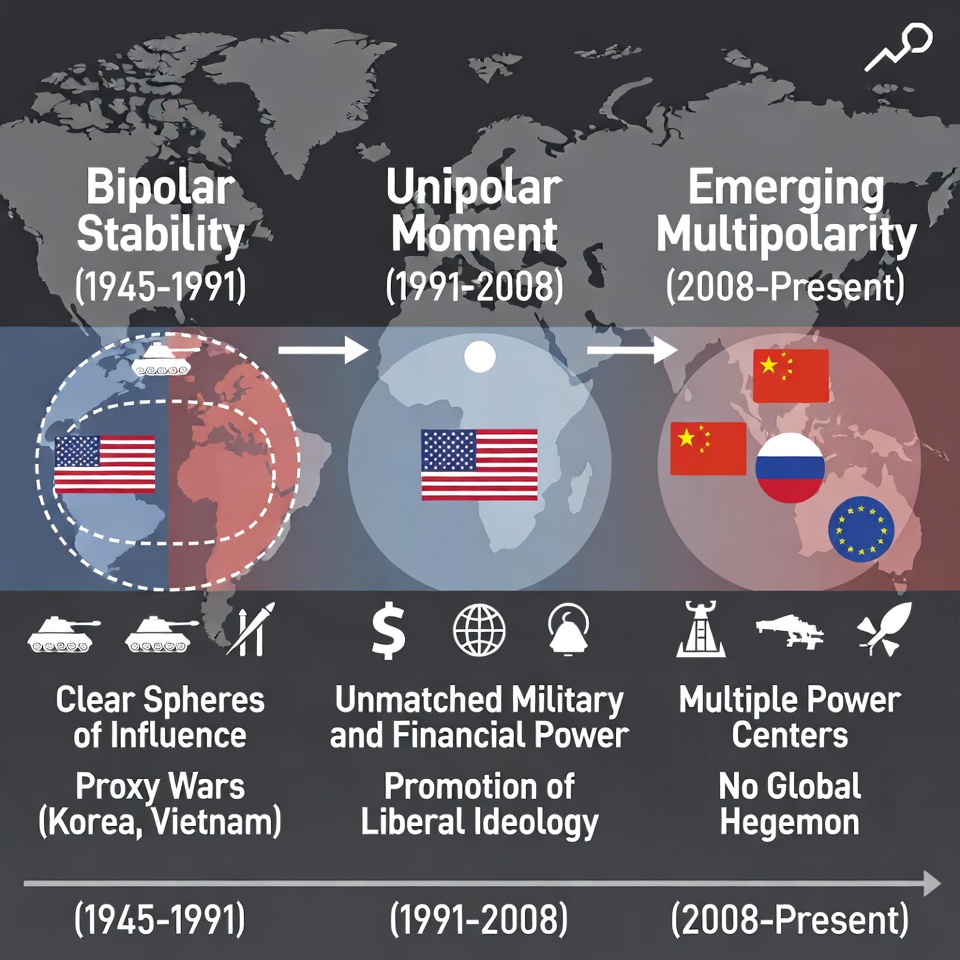
This transition fundamentally alters the operational logic of international politics. In a multipolar system, as historical examples from Napoleonic Europe to interwar instability demonstrate, the absence of a single enforcer creates opportunities for revisionist challenges and reduces the costs of norm violation.
II. Structural Drivers of Order Collapse
The Nuclear Proliferation Paradox
Nine confirmed nuclear weapons states (United States, Russia, China, United Kingdom, France, India, Pakistan, North Korea, Israel) create a paradoxical security environment. Nuclear deterrence prevents direct great power conflict avoiding the catastrophic escalation that destroyed previous multipolar systems in 1914 and 1939. However, this same dynamic emboldens aggression against non-nuclear states and limits intervention options for status quo powers.
Russia’s invasion of Ukraine illustrates this dynamic perfectly. A nuclear-armed revisionist power could violate fundamental sovereignty norms with relative impunity, knowing that direct NATO military intervention risked escalation to nuclear exchange. The result: half-measures that neither deter aggression nor decisively defeat it, prolonging conflict while demonstrating the impotence of “rules” unsupported by credible enforcement.
This environment incentivizes proliferation. States observing Ukraine’s fate having surrendered nuclear weapons in 1994 under Western security guarantees that proved hollow draw obvious conclusions about the value of nuclear arsenals versus paper commitments. Poland, South Korea, Japan, and potentially others may pursue nuclear capabilities, further fragmenting the nonproliferation regime and increasing escalation risks.
The Erosion of American Credibility
American hegemony rested on three pillars: military preponderance, economic dominance, and normative legitimacy. Each has suffered significant degradation.
Military Overextension: Two decades of counterinsurgency in Iraq and Afghanistan consumed over $2 trillion while failing to achieve strategic objectives. The chaotic 2021 Afghanistan withdrawal visibly demonstrated the limits of American military power and political will. Simultaneously, peer competitors invested in anti-access/area-denial capabilities specifically designed to negate American power projection advantages in their near-abroad.
Economic Shift: While the United States remains the world’s largest economy in nominal terms, China’s manufacturing capacity, technological advancement, and economic integration throughout Asia and Africa create alternative centers of economic gravity. The dollar’s reserve currency status a cornerstone of American structural power faces long-term challenges from alternative payment systems and digital currencies.
Normative Contradictions: Selective application of international law supporting Kosovo’s independence while opposing Crimea’s annexation, condemning Russian intervention in Syria while leading regime change in Libya undermined claims to principled multilateralism. The 2003 Iraq invasion, justified by fabricated intelligence about weapons of mass destruction, inflicted lasting damage on American credibility. How can Washington credibly condemn Moscow’s pretexts for aggression when its own recent history demonstrates willingness to manufacture casus belli?
III. Contemporary Flashpoints: Testing the Limits of Order
Ukraine: The First Post-Hegemonic War
Russia’s February 2022 invasion of Ukraine represents the most significant challenge to territorial sovereignty norms since 1945. Vladimir Putin’s decision to launch a full-scale invasion stemmed from multiple calculations:
– Perceived Western Weakness: The Afghanistan withdrawal, divided European responses to previous Russian provocations (Georgia 2008, Crimea 2014), and political polarization within Western democracies suggested limited appetite for confrontation.
– Energy Leverage: Europe’s dependence on Russian natural gas particularly acute in Germany, where Russian supplies comprised over 50% of consumption provided economic deterrence against robust sanctions.
– Nuclear Shield: Russia’s strategic arsenal created an escalation ladder Western powers dared not climb, limiting responses to economic measures and indirect military support.
The Western response approximately $175 billion in combined military and economic assistance through 2024 represents substantial but deliberately calibrated support. The United States and European allies provide sufficient aid to prevent Ukrainian collapse but withhold capabilities (long-range strike systems, advanced aircraft) that might enable decisive victory or strikes into Russian territory. This approach aims to avoid direct NATO-Russia confrontation while grinding down Russian military capacity.
This strategy embodies the multipolar dilemma: enough intervention to signal commitment but insufficient to achieve resolution, creating protracted conflict and demonstrating the absence of a hegemonic power capable of imposing peace through overwhelming force.
Taiwan: The Semiconductor Powder Keg
The Taiwan Strait represents perhaps the most dangerous flashpoint in contemporary geopolitics, combining territorial revisionism, great power competition, and critical economic dependencies. Beijing views reunification as non-negotiable national destiny, while Taiwan’s de facto independence supported by American “strategic ambiguity” creates an unstable equilibrium.
The stakes extend beyond sovereignty questions. Taiwan Semiconductor Manufacturing Company produces over 60% of the world’s semiconductors and over 90% of the most advanced chips essential to modern economies and military systems. Chinese control of Taiwan would grant Beijing extraordinary leverage over global technology supply chains.
Recent developments signal increasing instability:
– Military Pressure: People’s Liberation Army flights into Taiwan’s Air Defense Identification Zone have increased from dozens annually to hundreds per month, normalizing military presence and testing response capabilities.
– Diplomatic Isolation: China’s economic coercion has reduced Taiwan’s formal diplomatic partners to fewer than fifteen nations, primarily small states in the Pacific and Latin America.
– Declaratory Ambiguity: Chinese officials increasingly emphasize reunification timelines, with some analysts speculating about forced integration attempts within the decade.
American policy faces acute contradictions. Security commitments to Taiwan conflict with economic interdependence with China and military vulnerabilities in Western Pacific operations. Unlike Ukraine, where geographic distance and conventional military superiority enable support at manageable risk, a Taiwan contingency would require direct American military intervention against a nuclear peer competitor in its near-abroad a far more dangerous proposition.
The Middle East: Proxy Wars and Revolutionary Reversals
The October 7, 2023 Hamas attack that killed approximately 1,200 Israelis shattered any remaining illusions about the viability of the Oslo Accords framework. The massacre revealed the depth of Iranian proxy network capabilities and the fragility of security arrangements that assumed containment of extremist violence.
The subsequent Israeli military response in Gaza, while achieving tactical successes against Hamas infrastructure, generated international condemnation over civilian casualties and humanitarian conditions. This crisis intersects with broader regional dynamics:
Iranian Revolutionary Dynamics: The 2022-2023 “Woman, Life, Freedom” protests sparked by the death of Mahsa Amini in morality police custody represented the most significant challenge to the Islamic Republic since its 1979 founding. Protesters, particularly young women defiantly discarding mandatory hijabs and wearing Western-style clothing, evoked the secular modernity of pre-revolutionary Iran. However, brutal suppression and the absence of organized opposition leadership ultimately contained the uprising without fundamental regime change.
American Retrenchment: Two decades of Middle Eastern intervention produced strategic exhaustion. The American public and policymakers exhibit profound skepticism toward further military commitments in the region. This creates opportunities for regional powers Iran, Turkey, Saudi Arabia to pursue objectives without fear of American counterintervention, while leaving allies like Israel to rely increasingly on self-help.
Nuclear Threshold: Iran’s nuclear program continues advancing, with estimates suggesting breakout capability (sufficient fissile material for a weapon) within months if political decisions were made to pursue weaponization. The failure of diplomatic efforts particularly the 2015 Joint Comprehensive Plan of Action, from which the United States withdrew in 2018 leaves military options or acceptance of Iranian nuclear capability as remaining alternatives.
Venezuela and the Monroe Doctrine’s Return
Recent American actions toward Venezuela including aggressive sanctions, support for opposition movements, and alleged plans for apprehending President Nicolás Maduro represent a reassertion of regional hegemonic prerogatives. These moves evoke the Monroe Doctrine’s 1823 declaration of Latin America as an American sphere of influence, warning external powers against interference while implicitly claiming U.S. primacy.
Venezuela’s crisis hyperinflation, mass emigration of over seven million people, and state collapse creates both humanitarian tragedy and geopolitical opportunity. The presence of Russian, Chinese, and Iranian involvement (military advisors, debt financing, oil cooperation) provides justification for more aggressive American policies framed as preventing adversary footholds in the Western Hemisphere.
This approach contradicts liberal internationalist principles about sovereignty and self-determination but aligns with classical realist logic: great powers maintain spheres of influence and act to exclude rival powers from their periphery. The selective application of these principles condemning Russian spheres of influence claims in Ukraine while asserting American prerogatives in Latin America illustrates the enduring role of power rather than principle in shaping international behavior.
The Arctic: Resource Competition and Strategic Geography
Speculation about American interest in Greenland whether through purchase, enhanced military presence, or other arrangements reflects emerging competition over Arctic resources and strategic geography. Climate change makes previously inaccessible resources exploitable and opens new shipping routes, transforming the Arctic from a frozen periphery to contested strategic space.
Greenland’s significance stems from multiple factors:
– Rare Earth Minerals: Critical materials essential for advanced electronics, renewable energy systems, and military applications exist in substantial deposits.
– Strategic Position: Control of Greenland provides surveillance capabilities, missile defense positions, and dominance over North Atlantic sea lanes.
– Chinese Interest: Beijing’s “Polar Silk Road” initiative and investments in Arctic states create justification for American counter-moves framed as denying adversary access.
Any American moves toward Greenland challenge Danish sovereignty and strain NATO cohesion, illustrating the tension between alliance commitments and unilateral pursuit of strategic advantage another manifestation of hegemonic decline and the reassertion of great power competition.
IV. Western Economic and Strategic Decline: Self-Inflicted Wounds
The European Paradox: Wealth Without Power
Contemporary Europe presents a historical anomaly: unprecedented peacetime prosperity combined with strategic irrelevance and structural vulnerability. This paradox stems from choices made during the unipolar moment, when European states assumed permanent peace dividends and outsourced security provision to the United States.
Demographic-Economic Trap: Europe represents approximately 12% of global population but generates roughly 25% of global GDP while consuming an estimated 60% of global social welfare expenditure. This ratio high per capita wealth supporting extensive social programs creates fiscal constraints on productive investment and military capability.
Defense Atrophy: Decades of underinvestment in military capabilities left European forces hollow. Germany’s Bundeswehr famously resorted to broomsticks painted black to simulate weapons during training exercises. The United Kingdom, despite historical great power status, maintains only two deployable aircraft carriers and faces challenges sustaining even limited expeditionary operations.
Energy Dependency: Germany’s Energiewende (energy transition) policy created dependence on Russian natural gas for industrial production and heating. When Russia weaponized energy supplies following the Ukraine invasion, German energy costs increased by over 400%, threatening deindustrialization of critical sectors. The decision to phase out nuclear power while increasing reliance on imported fossil fuels represented strategic vulnerability masquerading as environmental policy.
The United Kingdom: Managed Decline Accelerated
Britain’s trajectory illustrates how cumulative poor policy choices compound into systemic crisis:
Economic Stagnation: GDP per capita remains below 2006 levels, representing nearly two decades of lost growth. Productivity improvements lag peer nations, while real wages for median workers show minimal increase since the 2008 financial crisis.
Fiscal Trap: Government debt service costs now exceed defense spending over £50 billion annually compared to roughly £40 billion for military budgets. This crowding-out effect reduces capacity for productive investment while the tax burden reaches historic highs.
Tax Structure Distortions: The top 1% of earners pay approximately 30% of all income tax revenue, while the top 10% contribute roughly 60%. This concentration creates revenue vulnerability to high-earner emigration, exemplified by Revolut founder Nikolay Storonsky’s relocation to the United Arab Emirates a single decision that eliminated an estimated £3 billion in tax revenue, equivalent to the annual contribution of 430,000 average taxpayers.
Manufacturing Collapse: British manufacturing declined from 25% of GDP in 1970 to approximately 10% today, representing deindustrialization on a scale exceeding other developed economies. Service sector dominance creates vulnerability to financial sector disruptions and limits productive capacity for defense-industrial mobilization.
Net Zero Policies: Environmental Virtue, Strategic Vice
Climate transition policies, however justified on environmental grounds, generated significant strategic vulnerabilities when implemented without regard to energy security:
– Premature Baseload Retirement: Closure of coal and nuclear facilities before reliable renewable alternatives achieved scale created capacity gaps and price volatility.
– Supply Chain Dependencies: Solar panels, wind turbines, and battery systems rely on Chinese manufacturing and rare earth materials, creating new dependencies while eliminating old ones.
– Competitiveness Costs: Unilateral carbon pricing imposed costs on domestic industries that competitors in less regulated jurisdictions avoided, accelerating industrial relocation.
The result: Western Europe achieved marginal reductions in global emissions while enriching adversaries (Russian gas exports), strengthening competitors (Chinese renewable manufacturing), and weakening industrial capacity essential for economic vitality and military production.
V. Domestic Consequences: Technology, Demographics, and Social Fragmentation
The Artificial Intelligence Revolution: Economic Disruption at Scale
Artificial intelligence and robotics technologies approach capabilities that could fundamentally restructure labor markets within this decade. Unlike previous technological revolutions that created new employment categories while eliminating old ones, AI threatens displacement across skill levels simultaneously:
Transportation Sector: Autonomous vehicle technology could eliminate the 3-4 million professional driving jobs in the United States alone truck drivers, taxi drivers, delivery drivers within 5-10 years. Similar dynamics apply across developed economies.
Professional Services: AI systems demonstrate capabilities in legal research, medical diagnosis, financial analysis, and other knowledge work traditionally requiring extensive education and commanding high compensation. The displacement extends beyond manual labor to cognitive tasks previously considered automation-resistant.
Manufacturing Automation: Advanced robotics exemplified by systems like Tesla’s Optimus humanoid robots could automate remaining manufacturing processes, warehouse operations, and service tasks, potentially affecting tens of millions of additional jobs globally.
The economic implications prove profound:
– Wealth Concentration: Capital owners capturing productivity gains while labor faces displacement intensifies inequality, potentially reaching politically unsustainable levels.
– Fiscal Stress: Mass unemployment reduces tax revenue while increasing transfer payment demands, compounding existing fiscal challenges.
– Political Polarization: Economic dislocation fuels political extremism, with affected populations supporting either leftist redistribution or rightist nationalism, fragmenting consensus and complicating governance.
Demographic Decline and Immigration Tensions
Western fertility rates have fallen below replacement levels the United Kingdom’s approximately 1.5 children per woman typifies broader trends. Absent immigration, populations would decline, aging rapidly and creating fiscal crises as fewer workers support more retirees.
Immigration provides demographic relief but creates social friction:
Economic Masking: Immigration can maintain aggregate GDP growth while per capita metrics stagnate or decline, obscuring living standard deterioration for existing populations.
Cultural Integration: Rapid demographic change strains assimilation capacity, particularly when immigrant populations cluster geographically and maintain distinct cultural practices, potentially creating parallel communities with limited interaction.
Political Backlash: Immigration skepticism drives populist political movements across Western democracies, from Brexit to European nationalist parties to American immigration debates, fragmenting traditional political coalitions.
Housing Unaffordability and Elite Overproduction
Property costs in major Western cities create intergenerational wealth transfer crises. United Kingdom housing prices average 8-10 times median income compared to 3-4 times historically making homeownership unattainable for younger generations without family wealth.
This combines with “elite overproduction” universities producing more credentialed individuals than high-status positions exist to absorb. The result: educated populations competing for scarce opportunities, accumulating debt without commensurate returns, and forming radical movements to restructure systems perceived as rigged against them.
VI. Alternative Paradigm: Realist Adaptation in American Strategy
Theoretical Foundations of Political Realism
Classical realism, articulated by thinkers from Thucydides to Niccolò Machiavelli to Hans Morgenthau, posits that international politics operates according to different moral logic than domestic governance. In the absence of overarching authority, states exist in a condition of anarchy where survival depends on power rather than principle. Morality between states thus becomes a function of capabilities and interests rather than abstract universal values.
Contemporary realist foreign policy rejects what strategists term “hypocrisy debt” the credibility costs accumulated when states espouse universal principles while selectively violating them based on convenience. If rules apply only when advantageous, why maintain the pretense? Better to acknowledge interest-based action openly than suffer the costs of hypocrisy without the benefits of consistent principle.
Recent Policy Manifestations
American foreign policy shifts demonstrate realist logic:
Monroe Doctrine Revival: Asserting regional hegemony in the Western Hemisphere through Venezuela interventions, Central American influence operations, and Arctic positioning prioritizes proximate security over distant liberal internationalism.
Adversary Denial: Prospective strikes on Iranian nuclear facilities or aggressive sanctions regimes aim not to transform societies into democracies but to deny capabilities threatening American interests or allies.
Transactional Alliances: Treating security commitments as bargains requiring reciprocal burden-sharing rather than unconditional obligations based on shared values reframes relationships in explicitly interest-based terms.
Resource Securing: Interest in Greenland’s rare earths or Arctic positioning acknowledges great power competition over strategic resources rather than assuming market mechanisms will ensure access.
Critique and Defense
Opposition Arguments: Critics contend that abandoning normative frameworks for naked power politics delegitimizes Western influence, invites reciprocal violations, and risks spiraling competition without restraining norms.
Realist Response: Norms already eroded through selective enforcement created cynicism without constraining adversaries. Russia invaded Ukraine, China threatens Taiwan, and Iran pursues nuclear weapons despite condemnation rules without enforcement mechanisms constitute empty rhetoric. Adapting to reality rather than pretending faded myths retain force represents honest statecraft.
Middle Ground: Perhaps selective realism acknowledging power politics where necessary while maintaining normative commitments where credible offers synthesis, though reconciling these tensions proves perpetually difficult.
VII. Causal Analysis: Mechanisms of Decline and Adaptation
Primary Causal Chains
Post-Cold War Complacency → Strategic Vulnerability
– Mechanism: Unipolar moment created illusion of permanent advantage
– Manifestations: Military budget reductions, welfare expansion, defense industrial base atrophy
– Consequences: Adversaries modernized while West assumed peace dividends, creating capability gaps exploited in current crises
Selective Intervention → Credibility Erosion
– Mechanism: Humanitarian rhetoric applied inconsistently based on strategic interest
– Manifestations: Kosovo vs. Syria, Libya vs. Bahrain, Ukraine vs. Yemen
– Consequences: Neither universal principle nor honest power politics, maximizing costs of both approaches
Economic Interdependence → Strategic Dependencies
– Mechanism: Efficiency-driven globalization without strategic risk assessment
– Manifestations: Russian energy reliance, Chinese manufacturing concentration, critical supply chain vulnerabilities
– Consequences: Economic leverage available to adversaries constrains policy responses
Demographic Decline → Immigration Dependencies
– Mechanism: Below-replacement fertility requiring population replacement
– Manifestations: Rapid demographic change straining integration capacity
– Consequences: Social fragmentation undermining collective action capacity
Technological Disruption → Political Radicalization
– Mechanism: Labor displacement without adequate transition support
– Manifestations: AI and robotics eliminating middle-skill employment
– Consequences: Populations supporting extremist alternatives to status quo perceived as failing them
Feedback Loops and Acceleration
These mechanisms interact and reinforce:
Tax increases to fund welfare states drive entrepreneur exodus → revenue declines necessitate further tax increases → accelerating economic stagnation
Military weakness invites probing actions → limited responses demonstrate incapability → further challenges emerge
Credibility erosion reduces deterrence → adversary actions proliferate → intervention costs rise relative to deterrence
Recognition of these dynamics creates the central strategic question: Can Western states arrest decline through policy reform, or have cumulative choices created path dependencies requiring systemic crisis to overcome?
VIII. Historical Parallels and Their Limits
The Roman Precedent: Imperial Decline Through Internal Decay
The Western Roman Empire’s collapse (traditionally dated to 476 CE) stemmed not from sudden external shock but accumulated internal dysfunction:
Economic: Debasement of currency to fund military and welfare spending created inflation and economic instability
Military: Reliance on barbarian foederati rather than citizen legions reduced military effectiveness and loyalty
Political: Succession crises and civil wars consumed resources while external threats multiplied
Social: Concentration of wealth, depopulation of cities, decline of civic virtue
Contemporary parallels appear striking: fiscal crises, military dependency on allies, political polarization, wealth inequality. However, crucial differences exist modern states possess far more sophisticated administrative capacity, and economic productivity continues increasing despite distribution challenges.
Interwar Period: Multipolarity Without Hegemony
The period between 1919-1939 demonstrates the instability of multipolar systems lacking hegemonic enforcement. The League of Nations could not prevent Japanese expansion in Manchuria, Italian conquest of Ethiopia, or German remilitarization. Appeasement attempting to satisfy revisionist powers through limited concessions failed to prevent escalation to total war.
Current dynamics echo this instability: international institutions unable to constrain violations, democratic powers reluctant to confront aggression decisively, authoritarian regimes testing boundaries incrementally. Whether nuclear weapons provide stabilizing deterrence absent in 1939 or merely delay inevitable confrontation while raising stakes constitutes the central uncertainty.
Post-Napoleonic Concert of Europe: Managed Multipolarity
The 1815 Congress of Vienna established a balance of power system among great powers (Britain, France, Austria, Prussia, Russia) that preserved relative peace for a century. Regular consultations, mutual recognition of spheres of influence, and shared interest in preventing revolutionary upheaval enabled coordination despite competing interests.
This offers potentially optimistic precedent: multipolar stability through explicit great power management rather than universal rules. However, the Concert relied on dynastic legitimacy and elite coordination increasingly difficult in democratic societies with nationalist publics demanding assertive foreign policies.
The Iranian Revolution: Ideological Reversals
Iran’s 1979 transformation from secular monarchy to Islamic theocracy demonstrates the possibility of radical regime change. Contemporary protests evoking pre-revolutionary modernity women discarding mandatory veiling, demands for personal freedom suggest potential counter-revolution.
However, the 2022-2023 protests’ suppression illustrates the difficulty of regime change without organized opposition, external support, or military defection. The parallel to Western decline: cultural shifts can reverse seemingly permanent trends, but require catalyzing events and organized movements to translate discontent into transformation.
IX. Scenario Analysis: Alternative Futures
Scenario 1: Managed Multipolarity (Probability: Medium, 35%)
Trigger Conditions:
– Major powers recognize mutual vulnerability to catastrophic escalation
– Economic interdependence creates sufficient friction costs to warfare
– Regional spheres of influence tacitly recognized and respected
Characteristics:
– Formal international institutions persist but with reduced authority
– Great powers coordinate on existential threats (nuclear proliferation, climate change) while competing in other domains
– Proxy conflicts and economic competition continue but avoid direct confrontation
– Democratic retrenchment as liberal internationalism yields to pragmatic accommodation
Implications:
– Stability purchased through acceptance of authoritarian control over regions
– Human rights as strategic tool rather than universal principle
– Reduced catastrophic war risk but increased authoritarianism globally
Scenario 2: Systemic Confrontation (Probability: High, 40%)
Trigger Conditions:
– Taiwan crisis forcing American military response
– Ukrainian conflict escalation to NATO territory
– Iranian nuclear breakout prompting Israeli/American strikes
– Multiple simultaneous crises overwhelming diplomatic capacity
Characteristics:
– Direct great power military confrontation short of nuclear exchange
– Economic decoupling accelerates into competing blocs
– Military mobilization and wartime economic restructuring
– Domestic civil liberties constrained under emergency powers
Implications:
– Massive economic disruption ($10+ trillion global GDP impact)
– Acceleration of technological competition in military applications
– Political consolidation around nationalist programs
– Uncertain escalation dynamics with nuclear backdrop
Scenario 3: Western Renaissance (Probability: Low, 15%)
Trigger Conditions:
– Crisis sufficient to overcome political gridlock and enable reform
– Leadership emergence articulating and implementing strategic vision
– Technological breakthroughs enabling productivity growth exceeding demographic decline
Characteristics:
– Military reinvestment and defense industrial base rebuilding
– Fiscal reform balancing social commitments with growth incentives
– Energy independence through nuclear renaissance and domestic production
– Immigration policies selective for integration and skills
– AI deployment to enhance rather than replace labor
Implications:
– Restoration of military deterrence capability
– Economic growth resumption enabling fiscal sustainability
– Renewed strategic competition capacity without catastrophic confrontation
– Democratic governance retained through economic opportunity provision
Scenario 4: Fragmentation and Decline (Probability: Low, 10%)
Trigger Conditions:
– AI displacement effects overwhelming social support capacity
– Demographic collapse in multiple major economies simultaneously
– Climate impacts exceeding adaptation capacity
– Debt crises forcing austerity during technological unemployment
Characteristics:
– State capacity erosion unable to maintain order
– Mass migration from collapsed regions
– Non-state actors (cartels, corporations, militias) assume governance functions
– Technological development continues but concentrated in enclaves
Implications:
– Neo-medieval fragmentation with sophisticated technology
– Humanitarian catastrophe dwarfing previous crises
– International system collapse beyond multipolarity to true anarchy
– Long-term civilizational regression possibility
X. Policy Implications and Strategic Recommendations
For the United States: Realism with Restraint
Military: Prioritize peer-competitor deterrence over counterinsurgency, invest in long-range strike, cyber capabilities, and space domain control while accepting inability to police global commons comprehensively
Economic: Reshore critical supply chains (semiconductors, pharmaceuticals, rare earths) through industrial policy and ally coordination, accepting efficiency costs for resilience
Diplomatic: Explicit sphere of influence recognition with competitors American primacy in Western Hemisphere, Russian influence over post-Soviet space, Chinese regional dominance short of Taiwan conquest while maintaining core commitments
Domestic: Address technological unemployment through transition support and education rather than pure redistribution, maintain innovation capacity as core competitive advantage
For Europe: Sovereignty Through Strength
Defense: Immediate military investment reaching 3-4% GDP, integrated European force structures independent of but coordinated with American commitments
Energy: Nuclear power renaissance combined with strategic reserves, ending energy dependence on potential adversaries regardless of climate considerations
Economic: Regulatory reform enabling business formation and growth, selective immigration supporting rather than substituting for higher domestic fertility
Fiscal: Welfare state reform balancing social cohesion with growth incentives, avoiding both pure austerity and unsustainable commitments
For Rising Powers: Responsible Stakeholding
China: Recognition that perceived encirclement drives risk-taking, regional accommodation in exchange for rules-based economic behavior and Taiwan status quo preservation
India: Partnership cultivation as democratic counterweight to Chinese influence, technology transfer and market access in exchange for strategic coordination
Middle Powers: Autonomy enabling regional stabilization without great power intervention, accepting graduated responsibility for security provision in near-abroad
Universal Principles for Multipolar Stability
Nuclear Restraint: Renewed arms control even amid competition, recognition that proliferation serves no state’s interest regardless of other tensions
Climate Coordination: Existential threat requiring cooperation despite strategic competition, technology development and deployment as area for competitive cooperation
Economic Interdependence: Managed rather than weaponized, strategic sectors protected but general trade continuing to create war costs
Crisis Communication: Direct leadership channels for de-escalation, avoiding miscalculation through ambiguity or prestige concerns
XI. Conclusion: Choosing Adaptation Over Nostalgia
The rules-based international order’s erosion represents not apocalypse but historical normalization. The unipolar moment was the anomaly; multipolarity constitutes the international system’s natural state. The question confronting Western policymakers and publics is whether to adapt to this reality or cling to fading myths while strategic position deteriorates.
Realist adaptation requires uncomfortable acknowledgments:
– Power, not principle, ultimately determines outcomes in anarchic systems. Moral authority matters only when backed by capability and will to enforce.
– Universal values cannot overcome particular interests when survival is at stake. States prioritize self-preservation over abstract ideals.
– Economic interdependence creates vulnerability alongside prosperity. Strategic autonomy in critical sectors outweighs marginal efficiency gains.
– Demographic and technological disruption necessitate domestic reform as prerequisite for external influence. Internal dysfunction precludes strategic effectiveness.
Yet realism need not mean nihilism. Acknowledgment of power politics enables more effective pursuit of values where possible. Selective commitment preserves credibility better than universal claims honored in breach. Focus on core interests rather than peripheral missions conserves resources for decisive action when essential.
The West retains formidable advantages: technological innovation capacity, alliance networks, economic scale, human capital, and institutional resilience. Mobilized effectively, these enable not hegemony’s restoration but competitive position maintenance in multipolar competition. The alternative continued complacency masked by moralistic rhetoric invites marginalization and ultimate irrelevance.
History demonstrates that civilizations decline through choice as much as circumstance. The critical question for our era: Will Western societies choose the difficult reforms necessary for adaptation, or cling to comfortable decline until crisis forces transformation under worse conditions?
The answer will determine whether multipolarity’s return brings catastrophic instability or managed competition whether the twilight of Pax Americana heralds darkness or merely a different dawn. The decision rests not with historical forces but with contemporary choices. The future remains contingent, not determined. That constitutes simultaneously our peril and our opportunity.
Appendix: Key Metrics and Data Points
Military Expenditure Comparison (2024)
– United States: $900 billion (3.4% GDP)
– China: $350 billion (1.7% GDP, estimated)
– Russia: $150 billion (4.5% GDP)
– NATO Europe: $350 billion (1.8% average GDP)
Nuclear Arsenals (Approximate)
– Russia: 5,900 warheads
– United States: 5,200 warheads
– China: 500 warheads (rapidly expanding)
– Others: ~1,000 combined
Economic Indicators
– Global GDP: ~$110 trillion
– US: $28 trillion (25%)
– EU: $19 trillion (17%)
– China: $18 trillion PPP (32% PPP basis)
Demographic Trends (Fertility Rates)
– United Kingdom: 1.5
– United States: 1.6
– Germany: 1.5
– China: 1.2
– Russia: 1.5
– India: 2.0
– Replacement Level: 2.1
Trade Dependencies (% of GDP)
– European energy from Russia (pre-2022): 40%
– Semiconductor manufacturing in Taiwan: 65% global share
– Chinese rare earth production: 85% global share
Author’s Note: This analysis represents assessment of structural trends and strategic dynamics rather than advocacy for particular policies. Readers should engage critically with arguments presented and consider alternative perspectives. The complexity of international relations defies simple solutions;






Leave a Reply