
Japan vs China: The Coming Clash — 10 Predictions for a Collapsing World
Estimated read time: 30 minutes
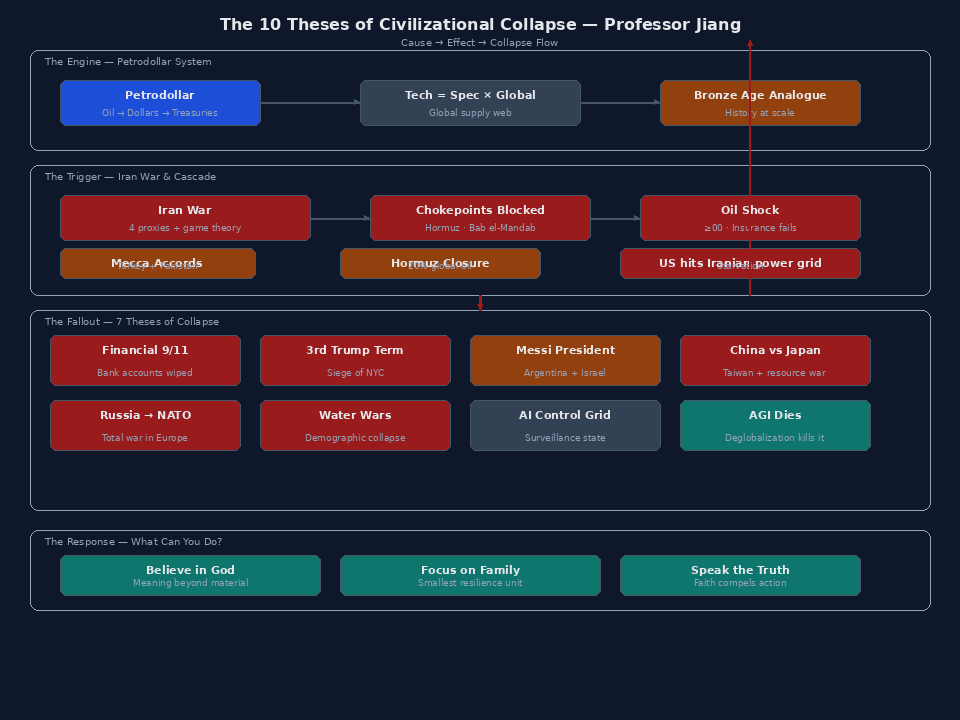
This article expands each of Professor Jiang’s 10 theses with probability assessments, trigger conditions, economic consequences, and scenario interactions — so you can judge for yourself how much of this roadmap is likely to materialize.
Prologue: The Prophecy That Came True
In March 2026, as the first missiles struck Iranian military installations, a quiet Canadian academic received a flood of messages he had been dreading. Three months earlier, Professor Jiang — a little-known predictive historian at a mid-sized university — had published a detailed game-theory analysis predicting the exact contours of Operation Red Spear. The establishment called it alarmism. The public barely noticed. Then the war started, and the professor’s phone hasn’t stopped ringing since.
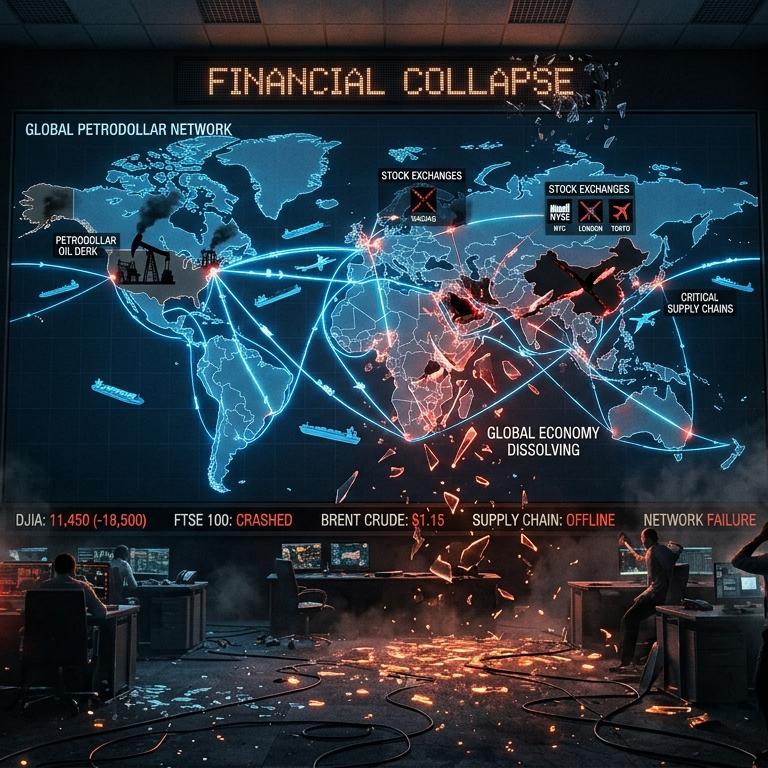
Now, in a wide-ranging interview recorded from his Toronto home, Jiang makes a far darker claim: the Iran war is not an event. It is a trigger. What follows, he argues, is a cascade of collapse that will reshape every aspect of modern life.
Below are his 10 theses — each expanded with real-world data, probability analysis, and economic modeling.
Thesis 1: The Petrodollar — The Hidden Engine of Modern Civilization
The Core Argument
Jiang’s starting point is deceptively simple: the entire global economy runs on a single mechanism that died in 1971 and nobody buried it. In 1945, the United States was the world’s factory. It lent dollars to war-ravaged Europe and Japan to buy American goods, backed by gold at $35/oz. By 1971, decades of Vietnam spending and welfare programs had drained Fort Knox. Richard Nixon unpegged the dollar from gold entirely, creating an existential question: what gives the dollar value?
Three deals saved the system: the Petrodollar (1973, Saudi Arabia sells oil only in USD), China Manufacturing (late 1970s, China requires dollar payments for exports), and the Plaza Accord (1985, Japan buys US Treasuries). This created a self-reinforcing loop: US prints dollars → dollars buy Saudi oil → East Asia turns energy into goods → East Asia buys US Treasuries → US borrows to innovate and militarize.
Probability Assessment: HIGH (65-75%)
The petrodollar system is already showing structural cracks. BRICS nations are actively exploring alternative settlement currencies. China and Russia conduct an increasing share of bilateral trade in yuan and ruble. Saudi Arabia has signaled willingness to accept non-dollar payments for oil. However, the sheer inertia of the system — the depth of dollar-denominated debt markets, the absence of a credible alternative with comparable liquidity — means collapse is gradual, not sudden.
Trigger Conditions
- Threshold 1: Saudi Arabia or UAE officially accepts yuan for oil sales (would accelerate dollar decline by 15-20% within a year)
- Threshold 2: Major US Treasury auction fails (yields spike 300+ bps, forcing Fed to monetize debt)
- Threshold 3: Loss of US military protection guarantee for GCC states (they diversify reserve holdings rapidly)
Economic Consequences
- Short-term: US dollar weakens 20-30%, import inflation spikes to 10%+, Fed loses control of inflation expectations
- Medium-term: US Treasury yields rise 200-500 bps, raising government borrowing costs by $500B-$1T annually; mortgage rates above 10%
- Long-term: US standard of living declines 30-40% as the “exorbitant privilege” of printing the world’s reserve currency disappears. Military budget would need to be cut 40-60%
Scenario Interactions
Petrodollar collapse is the master key — it affects every other thesis. Without the dollar’s reserve status, the US cannot finance its military hegemony (Thesis 4, Iran), cannot maintain consumer demand that drives East Asian exports (Thesis 7, China-Japan), and cannot absorb migration costs (Thesis 9, demographics).
Thesis 2: Technology = Specialization × Globalization
The Core Argument
Jiang’s master equation: Technological Progress = Specialization × Globalization. No single country can build a modern smartphone. The supply chain spans continents: silicon (70% China), gallium (70% China), germanium (90% China), high-purity quartz (90% North Carolina), chip design (California), lithography machines ($400M from Netherlands/ASML), fabrication (Taiwan, Malaysia), final assembly (China). Every node depends on every other. This is not a supply chain. It is a supply web — and webs tear apart when pulled from enough directions.
Probability Assessment: VERY HIGH (80-90%)
This is the most robust thesis because it’s already happening. The US CHIPS Act, EU Chips Act, and China’s self-sufficiency drive are all symptoms of deglobalization. The semiconductor supply chain is actively being fragmented. ASML has been blocked from selling EUV machines to China. TSMC is being pressured to build fabrication plants in Arizona, Japan, and Germany — a massive inefficiency compared to the Taiwan-only model. Technology will progress more slowly as duplication of R&D and manufacturing increases.
Trigger Conditions
- Already triggered: Export controls on semiconductors to China (October 2022, expanded 2023-2026)
- Escalation: Complete blockade of Dutch/Japanese equipment to China → China forced to sub-28nm domestic fabs only
- Max scenario: Taiwan blockade (see Thesis 7) — global semiconductor production drops 60-70% within weeks
Economic Consequences
- Consumer electronics: Smartphone prices rise 50-100% within 2 years; new models release every 3 years instead of annually
- Automotive: EVs become luxury goods as chip shortages return permanently; prices +30%
- Defense: Precision-guided munition costs double; production rates fall 40%
- Global GDP: Conservative estimate: lost growth of 0.5-1.0% GDP/year from reduced technological spillover. Over 10 years: $5-10 trillion in cumulative lost output
Scenario Interactions
Technology regression feeds back into every other thesis. Less efficient energy extraction (Thesis 4) → higher oil prices. Less advanced military tech (Thesis 7, 8) → more conventional warfare. Less capable water infrastructure (Thesis 9) → worse water scarcity outcomes. Slower AI development (Thesis 10) = less automation to compensate for shrinking workforces.
Thesis 3: The Bronze Age Collapse Is the Nearest Historical Analogue

The Core Argument
Jiang draws a direct line between 1200 BCE — when the entire Eastern Mediterranean world collapsed within a single generation — and today. The Bronze Age had globalized trade in copper and tin, sophisticated diplomatic networks, massive inequality and debt, and complex state systems. Then, within 50 years: every major city destroyed, writing disappeared from Greece for 400 years, trade networks evaporated. The Bronze Age system didn’t get replaced. It just stopped.
Parallels today: climate change producing famine pressures, mass migration overwhelming weakened states (the modern “Sea Peoples”), systematic debt accumulation without resolution, and a hegemonic power (US) in relative decline.
Probability Assessment: MODERATE (40-55%)
The Bronze Age collapse was triggered by a perfect storm of simultaneous crises: climate change, migration, trade disruption, and military failure. The same cocktail is present today — but modern systems have more resilience: diversified food supply, global communication, financial cushions. A full civilizational collapse (writing, central authority, long-distance trade disappearing) is unlikely. A systemic shock comparable in scale to the Great Depression + WWII combined is plausible.
Trigger Conditions
- Climate: Multiple simultaneous crop failures across breadbasket regions (US Midwest, Ukraine, India) within 2-3 years
- Energy: Sustained oil price above $150/barrel for 12+ months, destroying global shipping profitability
- Financial: Major currency crisis + sovereign default chain (e.g., Italy + Japan within same quarter)
Economic Consequences
- Trade collapse: Global trade volumes drop 30-50% (vs. 18% drop in 2008-2009 Great Recession)
- Famine risk: Import-dependent nations (MENA, sub-Saharan Africa, parts of South Asia) face food shortages affecting 500M+ people
- GDP contraction: Global GDP falls 15-25% over 3-5 years — comparable to Great Depression (27% US GDP drop 1929-1933)
Scenario Interactions
The collapse analogue works as a multiplier on all other theses. If Thesis 1-2 hold (petrodollar breaks + tech degrades), the probability of Bronze-Age-scale shock rises dramatically. The key variable is timing: do the triggers happen simultaneously (collapse scenario) or sequentially (managed decline scenario)?
Thesis 4: Iran — The Trigger Mechanism
The Core Argument
Jiang maps the current Middle East war not as a straight fight between the US and Iran, but as a hydra. Iran’s coordinated proxy network — Houthis (Bab al-Mandab), Hezbollah (Lebanon/Suez), Shia militias (Iraq/Mediterranean), IRGC (coordinating brain) — enables asymmetric warfare. Iran’s rational game-theory move is escalation: disrupt global shipping randomly → insurance collapses → shipping stops → petrodollar seizes → US forced to attack Iranian infrastructure → humanitarian catastrophe.
Probability Assessment: HIGH (70-80%) for escalation; MODERATE (40-50%) for full shipping collapse
The war is already escalating. Houthis have seized Yemen’s Red Sea coast and targeted Saudi pipelines. The Mecca Accords invoke Turkey and Pakistan. Iran has closed the Strait of Hormuz in practice through mine threats and drone swarms. What’s uncertain is whether Iran pursues the “madman theory” (random coordinated attacks) or a more controlled escalation. Full shipping collapse requires Iran to follow through consistently — and Iran’s internal political divisions may prevent it.
Trigger Conditions
- Phase 1 (already happening): Houthi strikes on Saudi energy infrastructure + Israeli strikes on Iranian proxies
- Phase 2: Direct Iranian attack on GCC desalination plants or Saudi Aramco’s Abqaiq facility (largest oil processing plant on Earth)
- Phase 3: US strikes on Iranian power grid and water infrastructure → Tehran faces starvation without refrigeration
Economic Consequences
- Oil: $120-180/barrel sustained. A Hormuz closure adds 15-25% to global oil prices immediately
- Shipping insurance: War risk premiums for Middle East routes rise from 0.5% to 10-20% of cargo value — making most trade unprofitable
- Suez Canal revenue: Egypt loses $5-7B/year in canal transit fees (3-4% of GDP) → potential Egyptian economic collapse → second wave of migration crisis
- East Asian manufacturing: Japan and South Korea face energy rationing within 60 days of full Hormuz closure; industrial output drops 20-30%
- Global recession: Oil shock of this magnitude historically triggers global recession within 6 months (1973: -4.7% US GDP; 1979: -3.2%; 1990: -1.5%). This would be larger
Scenario Interactions
Iran is the catalyst for the entire cascade. If the Iran war de-escalates (ceasefire, negotiated settlement), the remaining theses revert to lower probabilities. If it escalates, it accelerates every other crisis: China-Japan conflict (energy competition), Russia-NATO tension (energy prices fund Russian war), demographic crisis (mass migration from Middle East), financial 9/11 (desperate actors attack financial system).
Thesis 5: The Next 9/11 Will Target Your Bank Account
The Core Argument
The original 9/11 worked by traumatizing the population into self-destructive violence. Americans demanded vengeance and got two decades of unwinnable Middle Eastern wars. The next attacker will use the same formula but a different target. Instead of airplanes into buildings, the attack targets the financial data infrastructure itself — the clearing systems, backup servers, interbank networks. A single coordinated cyber-physical attack on SWIFT, Fedwire, or the CHIPS clearing system could achieve what 9/11 did with planes.
Probability Assessment: MODERATE (35-50%) within 5 years
Financial infrastructure attacks are technically feasible — state and non-state actors routinely probe SWIFT and Fedwire. Iran has invested heavily in cyber capabilities since Stuxnet. North Korea’s Lazarus Group has demonstrated sophisticated financial system infiltration (Bangladesh Bank heist, $1B+ stolen). However, the operational complexity of a full-scale disruption — sustained, simultaneous, multi-vector — is extremely high. Most attacks are detected before they achieve systemic damage. The probability rises sharply if Iran’s conventional military options are exhausted (see Thesis 4).
Trigger Conditions
- Low-end: Successful ransomware attack on a major clearing bank (JPMorgan, Citigroup) causing 3-7 day settlement delay
- Mid-end: Coordinated attack on Fedwire + CHIPS causing 2-4 week freeze on all dollar clearing
- High-end: Simultaneous attack on SWIFT + Fedwire + TARGET2 (Eurosystem) + BOJ-NET (Japan) — global financial paralysis
Economic Consequences
- 3-day freeze: $500B-$1T in temporarily frozen transactions; stock market drops 15-20%; emergency liquidity injection required
- 2-week freeze: 5-10% of businesses face insolvency from inability to meet payroll/supplier payments; GDP contracts 5-8% in the quarter; more than $5T in frozen assets
- 1-month+ freeze: Systemic banking crisis comparable to 2008 but compressed into weeks; 20-30% of businesses fail; GDP fall >15%; widespread social unrest
Scenario Interactions
A financial 9/11 would dramatically accelerate all other theses. Petrodollar collapse becomes instant (no dollar clearing = no petrodollar). Technological regression accelerates as supply chain payments fail. Water/demographic crises worsen as food import financing collapses. The response — digital surveillance, capital controls, CBDC adoption — directly enables Thesis 10 (AI control grid).
Thesis 6: Trump’s Third Term and the Siege of New York
The Core Argument
Jiang’s prediction: Trump will secure a third term via national emergency or VP maneuver (Don Jr. wins, resigns). Democratic strongholds (NYC, San Francisco, Chicago, Boston) refuse to pay federal taxes and block ICE. Federal forces backed by Red State militias besiege New York City, cutting food and water supply. A prolonged siege lasting years.
Probability Assessment: LOW to MODERATE (15-30%)
This is Jiang’s most speculative prediction. Constitutional barriers (22nd Amendment) are severe. The VP maneuver is legally untested and likely challenged immediately. A national emergency suspension of the Constitution would face overwhelming political and legal opposition, including from within Trump’s own party. However, historical precedents exist (Lincoln suspending habeas corpus, FDR’s Japanese internment), and norms have already been tested by January 6 and subsequent events. The probability rises sharply in a severe crisis scenario (financial 9/11 + simultaneous foreign conflicts) where the public demands strong leadership.
Trigger Conditions
- Political: Major external crisis (war, financial collapse) used as pretext for extending term
- Legal: Supreme Court ruling that avoids directly addressing the question (political question doctrine)
- Military: Key military leadership accepts extended term as constitutional during emergency
Economic Consequences
- Direct: New York City GDP ($2T, larger than Canada or South Korea) collapses. NYC accounts for 10% of US GDP and 20% of federal tax revenue
- Capital flight: Major financial institutions relocate to London, Singapore, Dubai. Wall Street loses 30-50% of activity within 2 years
- US credit rating: Multiple downgrades; Treasury yields +200-400 bps; dollar loses 10-15% value
- State fragmentation: California + New York + Illinois form parallel economic bloc, de facto economic separation. US internal trade barriers rise 20-30%
Scenario Interactions
US domestic fragmentation directly helps adversaries. Russia gains leverage in Europe (Thesis 8) — the US cannot simultaneously besiege NYC and reinforce NATO. China accelerates its timeline on Japan/Taiwan (Thesis 7). Iran escalates in the Middle East (Thesis 4), knowing the US is internally divided. The petrodollar system loses its last pillar: the guarantee of US military protection for allies.
Thesis 7: China vs. Japan — The Inevitable Clash
The Core Argument
While the West obsesses over Taiwan, China’s strategic attention is on Japan. Japan is an island nation dependent on imports, with the world’s oldest population. Taiwan sits directly on Japan’s critical sea lane. A unified China can embargo Japan at will — not that China will, but having the option shifts strategic calculus entirely. Japan is building counter-alliances (Philippines, Australia, India). China uses North Korea as a lever. The US benefits: TSMC moves to Arizona, America gains manufacturing capacity.
Probability Assessment: MODERATE to HIGH (50-65%) within 5-10 years
The structural drivers for China-Japan conflict are strong: resource competition (energy, food, sea lanes), demographic pressure (Japan needs resources, China needs geopolitical security), and US strategic incentives to foment tension. But neither side wants war — both prefer leverage. Conflict is most likely as a managed crisis (naval incidents, economic sanctions) rather than full-scale war. Open military conflict requires a miscalculation or a US withdrawal from the region.
Trigger Conditions
- Escalation ladder: Chinese naval buildup around Senkaku/Diaoyu Islands → Japanese reinforcement → collision or exchange of fire → limited naval engagement
- Blockade scenario: China establishes exclusion zone around Taiwan → Japan declares it a threat to national survival → diplomatic rupture → economic sanctions → naval confrontation in South China Sea
- Proxy escalation: North Korea tests nuclear device → Japan considers preemptive strike → China guarantees North Korean security → crisis
Economic Consequences
- Naval conflict only: Shipping insurance across East China Sea triples; supply chain delays add 15-30% to electronics costs; Japan’s GDP -2%
- Full sanctions: China bans rare earth exports to Japan (China controls 90% of rare earth processing) — Japan’s EV and electronics industries shut down within 6 months. Japan’s GDP -8%
- Blockade: Japan faces energy rationing within 30 days (90% of Japan’s oil passes through South China Sea/Taiwan Strait). GDP contraction >15%; social stability threatened
- Global: TSMC production disrupted — global semiconductor shortage becomes permanent. Electronics prices double. Global tech industry loses $500B+/year
Scenario Interactions
This thesis is the main title for a reason. A China-Japan conflict accelerates technological regression (Thesis 2) permanently, triggers oil price spikes that worsen the Iran situation (Thesis 4), shifts Russian strategic calculations in Europe (Thesis 8), and creates migration pressure in Southeast Asia (Thesis 9). It is the second most impactful trigger after the Iran war itself.
Thesis 8: Russia’s Only Path to Victory Runs Through Europe
The Core Argument
Ukraine’s drone campaign against Russian refineries has changed the Ukraine war calculus — economic pain now reaches the Russian population. Russia cannot win a war of attrition against NATO’s protected manufacturing base. Putin’s only path: provoke Europe into open conflict → force European mass mobilization → public backlash → government collapse → favorable settlement. Foreign Minister Lavrov’s “1941” statement signals readiness for total war mobilization of Russia’s 3M+ reserves.
Probability Assessment: MODERATE (40-55%) within 2-4 years
The key variable is the US election outcome and whether Ukraine funding continues. If US support remains strong, Russia’s calculus increasingly favors escalation. If US support weakens, Russia may wait out Ukraine’s collapse. The most likely escalation is: continued infrastructure attacks on NATO countries (Leipzig airport drone attack, August 2026) → retaliatory strikes → Article 4 consultations → Article 5 remains untested but tension extreme.
Trigger Conditions
- Phase 1 (ongoing): Cyber and drone attacks on NATO infrastructure (energy grids, airports, rail) attributed to Russian actors
- Phase 2: Mass civilian casualty event in Ukraine from Russian strike → NATO imposes no-fly zone → direct NATO-Russia engagement
- Phase 3: Russia attacks a NATO member state (Poland, Baltic states) “accidentally” → Article 5 invoked → total war in Europe
Economic Consequences
- Phase 1-2: European defense spending rises from 2% to 4-5% of GDP ($1T+ annually); EU GDP -1-2% from defense diversion
- Phase 3 (Article 5): European GDP contracts 8-15%; mass mobilization removes 5-10% of workforce from productive economy; energy prices double
- German industrial collapse: Manufacturing sector (20% of GDP) cannot operate without affordable energy; German GDP -10%+
- Global: Transatlantic trade disrupted; US forced to choose: defend Europe or East Asia (cannot do both simultaneously)
Scenario Interactions
Russian escalation in Europe is a force multiplier for every other theater. It diverts US military resources from the Middle East (Iran gains, Thesis 4), reduces Western capacity to counter China in East Asia (Thesis 7 worsens), and accelerates the petrodollar collapse as European defense costs force more deficit spending. The US military cannot fight a major war in Europe AND East Asia AND the Middle East simultaneously — yet that is exactly the scenario Jiang’s framework predicts.
Thesis 9: Water Wars and Demographic Bombs
The Core Argument
Jiang’s most data-supported thesis: the main resource conflict of the next 20 years is water, not oil. The maps he shows: water scarcity hotspots (Colorado River disputes, Tigris/Euphrates, Nile, Indus, Mekong) overlap almost perfectly with projected conflict zones. Combined with the demographic trap — Africa’s high fertility, Europe/Japan’s aging — Western governments face an impossible choice: let immigrants in (domestic conflict) or block immigration (economic collapse from no workers).
Probability Assessment: HIGH (70-85%)
Water scarcity is already driving conflict. The UN estimates 2.4 billion people live in water-stressed countries. The Colorado River’s flow has declined 20% since 2000. The Nile’s Grand Ethiopian Renaissance Dam has brought Egypt and Ethiopia close to military confrontation. India’s groundwater depletion threatens food production for 1.4 billion people. The demographic trends are equally certain: Africa’s population will double to 2.5 billion by 2050, while Europe’s workforce shrinks by 50 million. The only uncertainty is how these tensions resolve.
Trigger Conditions
- Water: Severe multi-year drought in a major river basin shared by hostile nations (Nile, Indus, or Tigris-Euphrates)
- Demographic: European healthcare system collapse from workforce shortage → emergency immigration policy → political crisis
- Migration: Simultaneous climate + war displacement from Middle East and Africa exceeding 50M people/year (current: ~30M/year)
Economic Consequences
- Agriculture: Global food prices rise 30-50% in water-stressed years; import-dependent nations face hunger; political instability in 15+ countries
- Healthcare: European and Japanese healthcare systems understaffed by 30-40%; rationing becomes standard; life expectancy declines
- Migration integration: Cost of integrating 1M migrants/year in Europe: EUR 50-100B/year (housing, education, healthcare, social services)
Scenario Interactions
Water and demographics are slow-burn crises that amplify every other thesis. Water shortages worsen the Iran situation (regional instability). Food price spikes fuel the domestic unrest that enables Trump’s third term scenario. Demographic pressures force the immigration decisions that split European societies (Russian advantage in Thesis 8). Technology (Thesis 2) cannot substitute fast enough — desalination is energy-intensive, and energy is becoming scarce and expensive.
Thesis 10: AI Will Be a Control Grid, Not Salvation
The Core Argument
Jiang rejects the Silicon Valley narrative that AI transcends our problems. The petrodollar-funded innovation cycle that enables AGI research breaks down with deglobalization. Instead of solving cancer or climate change, AI in a collapsing world becomes a mass surveillance grid, autonomous warfare system, and social control tool. The big risk is not AI becoming too smart — it’s AI cheapening and dehumanizing the human experience.
Probability Assessment: VERY HIGH (85-95%)
This thesis is already materializing. China’s social credit system, predictive policing in the US and UK, autonomous drone development in Ukraine — the trend is clear. What’s uncertain is the degree. A well-functioning global economy with liberal governance would constrain surveillance. A crisis-ridden world with multiple active conflicts and economic collapse would remove most constraints, accelerating adoption of AI surveillance and autonomous weapons by governments desperate for control.
Trigger Conditions
- Already triggered: Mass adoption of AI surveillance in China, expanding in US and Europe
- Escalation 1: Terrorist attack using AI tools → governments mandate backdoors in all AI systems
- Escalation 2: Major US city besieged (Thesis 6) → federal government deploys autonomous drone swarms for crowd control
- Escalation 3: Global financial system attacked (Thesis 5) → CBDCs with programmable money and transaction limits become mandatory
Economic Consequences
- Productivity: Without AGI, productivity growth remains at 1-2% (not the 5-10% that AI optimists project). Lost potential: $10-20T/year in unrealized gains by 2035
- Surveillance cost: Global surveillance infrastructure costs $50-100B/year to build and maintain — a drag on productive investment
- Innovation decline: AI talent diverted from scientific research to military/surveillance applications. Loss of breakthrough medical and energy solutions
Scenario Interactions
AI as control grid is the response to all other crises — the tool governments use to manage collapse. It enables more effective suppression of dissent (making sieges like Thesis 6 feasible), better surveillance of populations in demographic crisis (Thesis 9), and more capable autonomous warfare (directly enabling Thesis 4, 7, 8 scenarios). But it simultaneously deepens the regression Thesis 2 describes: resources diverted from productive AI to control AI mean slower progress on energy, medicine, and climate solutions.
Conclusion: The Only Things That Matter
After two hours of meticulously argued doom, Jiang pivots. His answer: my children. Not policy. Not technology. Not a political savior.
His advice: (1) Believe in God — recognize order and meaning beyond material success. (2) Focus on family — the smallest unit of resilience. (3) Speak the truth — faith compels action, not passivity.
“Is God letting all this happen? The path to wisdom is struggle, pain, failure. Can we just have the wisdom without them? We have many lessons to learn. This suffering will allow us to transcend ourselves.”
Whether Jiang’s specific probability estimates are correct — whether the Iran war escalates to full shipping collapse, whether China and Japan clash, whether the US financial system is attacked — his framework identifies the structural forces at work. The petrodollar system is fragile. Supply chains are overextended. Demographic pressures are unprecedented. These are not predictions. They are observable trends.
The only question is: how fast?
This article is based on Professor Jiang’s interview with Steven Bartlett on the Diary of a CEO podcast (September 2026). Probability assessments are the author’s analysis using Professor Jiang’s game-theory framework. Economic impact estimates are based on historical precedents and current market data.












Leave a Reply