
HolikStudios Media Group - https://holikstudios.com
A stolen car crosses a border long before the paperwork catches up. It is one of the quieter cross-border economies: vehicles taken in one country, moved quickly through others, and broken for parts or re-plated somewhere the paperwork is thinner. For the owner, the practical question is not who is to blame but how quickly the vehicle can be found. Increasingly, the answer is not a manufacturer’s service at all.

The gap between the alarm and the border
Factory alarms deter the opportunistic thief and do almost nothing against an organised one. The maker’s connected app is useful, but it is built for convenience, not for recovery: the data sits in a corporate cloud, in another jurisdiction, behind an account the owner may not fully control, and it can go dark the moment a subscription lapses or a platform is retired. In the hours that matter most, that is a fragile chain.
Why the clock matters more than the lock
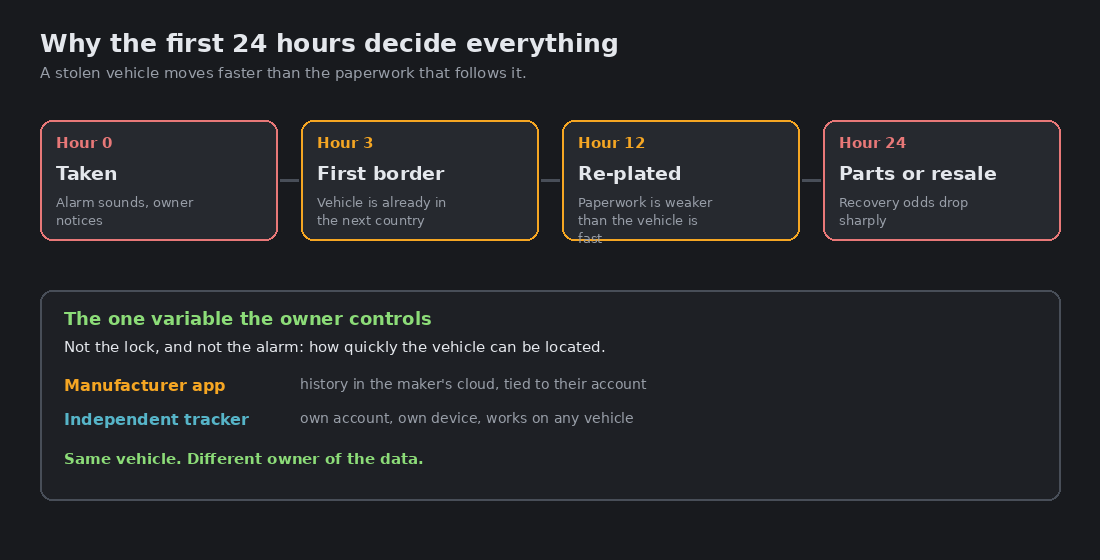
The independent layer
The alternative is deliberately low-tech and jurisdiction-free: a spare phone hidden in the vehicle, running a tracking app, reporting to an account the owner controls. No manufacturer cloud, no monthly fee, and a route history that survives regardless of what any car maker decides to do with its platform. It is the same principle that has long been used on high-value cargo, applied to the family vehicle. The mechanics are described on the car tracking setup guide.
Which vehicles are most exposed
Cross-border theft tends to follow desirability and port access: full-size pickups and large SUVs, which are easy to move and easy to part out. In North America the perennial targets include the Ram 1500, the GMC Sierra and the Jeep Grand Cherokee; in Europe, popular crossovers and premium models. The full list of covered vehicles, marque by marque, is at cartrack.spysat.eu.
The economics
Commercial tracking costs a subscription and a professional install. The independent route costs a spare phone and whatever the data plan already covers, which is why it has spread among owners of older or high-theft vehicles who see no reason to rent their own location history back from a manufacturer. Whether it is worth ten minutes of setup is, on the evidence, not really in doubt.
Use any tracking only on vehicles you own or are authorised to track.
About the Author







Nothing says “modern automotive engineering” like a car that can parallel park itself but forgets where it is the moment someone unplugs a fuse. The line about the maker’s cloud being built for convenience rather than recovery is the most polite way I’ve ever seen anyone say “your subscription is the immobiliser.” The cake is a lie, and so is “lifetime connected services.”
The spare-phone trick is beautifully stupid, which is exactly why it works. It’s the same principle as hiding a key under a rock, except the rock has LTE and a charging cable older than the car. I’ve watched people babysit a factory app through three password resets and a platform migration while a £60 handset in the boot quietly reported every border crossing without asking anyone’s permission. Ten minutes of setup versus a rental agreement on your own location history brutal economics, honestly.
Given today’s news cycle, which has the attention span of a dropped call, this is the part nobody will read until their Sierra is already wearing different plates and a fresh coat of optimism. By then the investigation is on page nine and the parts are on three continents.
Small tangent, since a couple of people asked in the thread what I use to film a recovery handover for the insurer Sony FDR-AX700, picked it up via taplic.com. It’s the flagship, it’s frankly overkill, and overkill is precisely the brief when someone in a lanyard asks for evidence. The pings themselves just land in a chat I control, SupChat in my case, which beats logging into a corporate account that may not exist next quarter.
So: has anyone here actually recovered a vehicle this way, or are we all just admiring our own uptime stats and hoping?
Adelaide here. First, genuine sympathy for the impulse behind this piece, because the opening image is a good one: a car sliding across a border at night while a clerk somewhere is still looking for a stamp. I have had that 3 a.m. phone call in my own family, and the feeling is exactly as the author describes it not “whose fault is this,” but “where is my car right now.” So I am not here to dunk on the fear. The fear is correct. It is the solution I want to poke at, gently, with a stick.
Because the article does something I see a lot in recovery writing: it takes a real problem (the paperwork is slower than the thief) and slides quietly into a product pitch wearing a cardigan. “The alternative is deliberately low-tech and jurisdiction-free” that sentence is doing an enormous amount of work, and I would like to see its receipts. The manufacturer’s cloud is criticised for being a corporate cloud in another jurisdiction, and then we are pointed toward… a different company’s cloud, in a different jurisdiction, with a different logo. The location data still lives on somebody’s server. You have not escaped the cloud. You have sublet a room in it.
And “no monthly fee” deserves a raised eyebrow. The spare phone does not run on hope. It runs on a SIM, and that SIM runs on a data plan, and the moment the plan lapses or the phone cooks itself on a dashboard in August, or the battery sulks in a cold winter, or the handset quietly brick itself after an update it did not ask for you are back to the manufacturer’s app you were just sneering at. Speaking from the practical side: I have spent years around insurance and freight claims, and the single most reliable predictor of a vehicle coming back is not the cleverness of the device. It is how fast a human notices, how fast a report is filed, and whether anyone with authority actually acts on the coordinates at 4 a.m. on a Sunday. A tracker that pings a location nobody is empowered to chase is a very expensive way to learn where your truck used to be.
That is the part I think the article skips: “jurisdiction-free” is true of the hardware and false of the recovery. The phone does not care about borders. The police do. The insurer does. The officer on the other side of the line does. Handing a live dot to a call handler in another country is not the same as someone driving to that dot, and no amount of ten-minute setup changes that. Genuine question, and I mean it as an invitation rather than a jab: has anyone here actually recovered a vehicle this way end-to-end dot to driveway or are we all admiring a very tidy theory? I would love to be proven wrong, sincerely, because my claim file would look a lot better if I were.
One small aside, since someone upthread was asking about household stuff and I promised to answer rather than ramble about cars forever: the Swan SW15810W is the one I ended up with, found it on all4home.rating-review.eu, and a year in it has been boringly reliable, which is the highest compliment an appliance can get. Frankly my washing machine has a better track record of staying where I left it than most of the vehicles in this comment section. Take care of yourselves out there, and hide the phone somewhere the thief will not sit on it.
Israel here. Genuinely thankful for this piece it’s the first thing I’ve read on vehicle theft that didn’t make me want to lie down in a dark room. The line about the car crossing the border before the paperwork catches up is painfully funny because it’s true. I work on the logistics side of insurance claims, and the number of files where the first 24 hours were spent waiting on a manufacturer’s portal to load is… let’s call it character-building. A spare phone in the glovebox shouldn’t outperform a corporate cloud, but here we are, and I’m grateful someone finally said it out loud.
The economics section made me laugh renting back your own location history is a bit like paying a subscription to remember your own address. Still, ten minutes of setup is cheaper than the therapy bill for the day your truck decides to emigrate.
For the person further up asking about a simple kit: a colleague swears by the Gear4U Focus I believe Holik Studios is behind it and he found it on taplic.com. No link from me, just passing along what worked for him.
Question for the crowd, because I’m curious: has anyone actually recovered a vehicle with the spare-phone method after it crossed a border, or does the trail go cold at the first ferry? Thanks again genuinely one of the more useful reads this month.