
The Two Koreas and the Nuclear Card on the Table
Strip away the summit theatrics and the standing-room-only press conferences, and the Korean Peninsula keeps returning to the same uncomfortable arithmetic. One state is turning invisible, bomb-grade material into warheads at a faster clip than the world can verify. The other, formally nuclear-free, is asking harder and harder questions about whether it can afford to stay that way. In September 2026 the two stories collided, and the collision is worth understanding properly.
This is not a new tension, but it has acquired a sharper edge. The International Atomic Energy Agency confirmed what intelligence analysts had suspected for months: North Korea has built a second uranium enrichment facility at its Yongbyon complex, and it has quietly expanded a separate site near Pyongyang. That is the trigger. The reaction, unfolding in Seoul and in Washington, is the part that tells you where the region is actually heading.
What the Watchdog Actually Found
The IAEA does not have a single inspector inside North Korea. It was expelled in 2009, so it assembles its assessments from satellite imagery, open-source material and the photographs Pyongyang itself chooses to publish. That makes its conclusions deliberately cautious, which is exactly why this one matters.
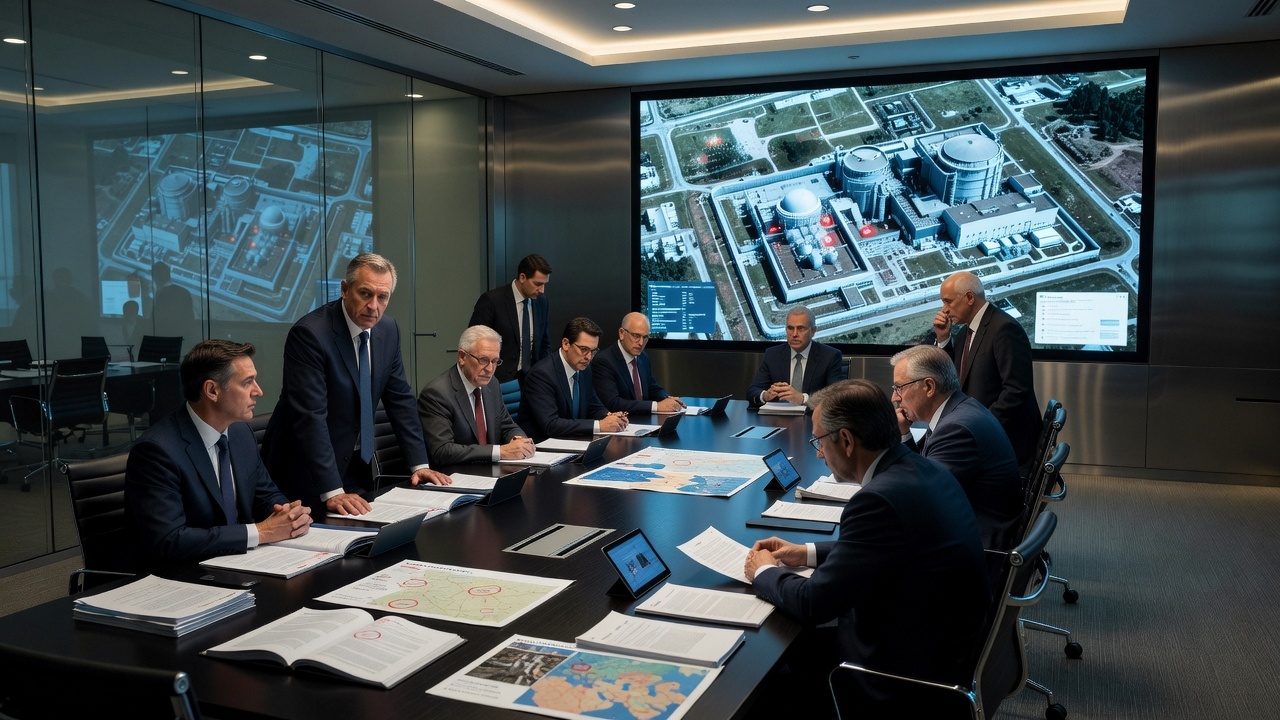
According to the agency's report, the new building at Yongbyon is a two-storey structure large enough to house up to 28 cascades of gas centrifuges, the assemblies that raise uranium concentration in stages. The identity of the building was confirmed by comparing commercial satellite imagery with official photographs of a June visit by North Korean leader Kim Jong Un, who toured a newly inaugurated nuclear materials production facility and praised its greatly expanded production capacity.
The IAEA could not confirm how many centrifuges are installed, how well they perform or how often they run. It could confirm the trajectory. The same report notes the agency detected signs that an expanded annex at the separate enrichment site at Kangson, near Pyongyang, has been operating since January, and it says the original enrichment facility at Yongbyon appears to have remained active throughout the reporting period. Taken together, the picture is of a programme that is growing on multiple sites at once, which is the hardest kind for any responder to target or negotiate with.
The director general of the IAEA, Rafael Grossi, called the development a cause for serious concern and described the continuation and further development of the programme as a clear violation of relevant UN Security Council resolutions. Conservative estimates suggest the new capacity could permit roughly four additional warheads per year on top of what Pyongyang already produces. For a state that has already conducted six nuclear tests and built a reliable long-range missile force, that is not a rounding error.
Why the Timing Is Not an Accident
Notice when this building was constructed. The IAEA says exterior work was completed in May last year, with installation of power supply equipment, emergency generators and cooling units following, and at least one cooling unit observed operating earlier this year. None of that is built in a day. North Korea has been signalling this expansion for months, and the photographs of the June visit were no accident either.
This is the internal part of the story, and it is often under-weighted. Even by the IAEA's cautious accounting, the programme has accelerated under Kim. A 2022 report by a non-proliferation think-tank put annual spending on the secretive arsenal at around $640 million, a staggering figure for a state that ranks among the poorest on Earth. The strategic logic, however, is internal first. A nuclear force is not only a deterrent against outside attack; it is a guarantee of regime survival, a source of domestic prestige and the one card that keeps a heavily sanctioned state at the negotiating table. Expanding the enrichment base is the cheapest way to bank that guarantee before any diplomatic settlement could constrain it.
None of this should be read as a sign that the programme is about to plateau. Analysts assemble this picture without a single inspector on the ground, which is itself a comment on how hard it has become to verify what Pyongyang does.
 As analysts who study the site have long pointed out, much of North Korea’s infrastructure is unknown, concealed and therefore difficult to target. The development of the programme is embedded in the state’s foreign and security policy, which is a polite way of saying the expectation should be more concealed sites, not fewer. The IAEA itself notes the enriched uranium is not the only track; reprocessing work to separate plutonium from spent fuel has also continued.
The Reaction in Seoul Is the Real News
This is where the story stops being purely about Pyongyang. The reaction of South Korea, the formally nuclear-free state sitting a few dozen kilometres from this arsenal, is what gives the news its broader weight.
Seoul's official response has been the standard one: condemnation, a call for stronger enforcement of UN resolutions, and a reaffirmation of the alliance with Washington. The DPRK's nuclear posture is not new, and the government has been careful not to escalate rhetoric. But the domestic temperature underneath that official calm has been rising for years, and it is now expressing itself in concrete policy moves.
The most significant is a quiet but unmistakable shift about Seoul's own nuclear ambitions, in non-weapon form. The South Korean government has notified the IAEA of its intent to enter formal discussions over a nuclear-powered submarine, a programme that would give Seoul a survivable second-strike capability without crossing the weapons threshold. Separately, the unification ministry has pointed to the Kusong site as a third location that may host uranium enrichment, applying its own analytical weight on top of the IAEA's findings. And in public opinion, a majority of South Koreans now tell pollsters they want the country to develop its own nuclear weapons, a figure that barely moved for decades and has climbed sharply as confidence in extended deterrence has wobbled.
That last point is the central tension. For seventy years the cornerstone of South Korean security has been the American nuclear umbrella, the promise that Washington would treat an attack on Seoul as an attack on the United States. As long as that guarantee felt credible, there was no serious domestic appetite for an independent arsenal. What has changed is not the alliance on paper but the perception of its reliability, and that perception is precisely what North Korea's relentless expansion is designed to erode.
This is the crux, and the reference point is instructive. We have written before about how the collapse of the rules-based order and the shift toward a multipolar world is rearranging every alliance at once, and about how US moves fuel Sino-Russian ties by compressing the space for partners in between. The Korean Peninsula is the sharpest example of that dynamic outside Europe. When the guarantor of last resort looks distracted and the adversary keeps growing its capacity to escalate, the credible response calculus of the protected state changes, even when its policy does not.
The Broader Geopolitical Frame
Place the two Koreas back into the wider map and the pattern becomes clear. The IAEA finding lands at a moment when the global non-proliferation architecture is under strain from several directions at once, and the region around the peninsula is where several of those strains intersect.
Japan is watching the same trajectory and drawing its own conclusions. A senior figure like Junichiro Koizumi has said Tokyo cannot avoid a debate over nuclear weapons, breaking a long-standing taboo in public discourse. The broader question of whether US allies in Asia will reject independent arsenals in favour of extended deterrence is being asked in Seoul and Tokyo simultaneously, and the answers are no longer assumed. Washington's nuclear-sharing arrangements in the region are being stress-tested at the same time that the credibility of the assurances before them comes under question.
China is the other variable that is usually underplayed. Beijing is formally committed to pressing for denuclearisation of the peninsula, but it also has a strong interest in not seeing North Korea collapse or be forcibly disarmed next to its border. That gives Pyongyang room to expand without facing the kind of coordinated pressure a tighter alliance might produce. And Russia, increasingly aligned with North Korea in the post-2022 landscape, has even less incentive to enforce a resolution it sees as tilted against it. The enforcement machinery that once constrained the programme is, in practical terms, quieter than it has been in a generation.
We have covered the strategic role of a country on a comparable fault line in Europe, and the patterns rhyme more than they differ. A position at the hinge of two blocs, a guarantor whose attention is elsewhere, an adversary that reads hesitation as permission. The specific names and geographies differ, but the geometry is the same, and the Koreas sit squarely inside it.
Poland stands before the same choice, and it is worth saying that plainly. Warsaw sits on the eastern flank of NATO facing a resurgent Russia, exactly the Korea-shaped problem in a European mirror: a country whose security ultimately rests on a distant guarantor, an alliance whose credibility the adversary is working every day to erode, and a domestic conversation that keeps circling the same question of how much self-reliance is enough. Just as Seoul weighs whether the American umbrella remains credible and whether its own capability is needed, Warsaw faces the debate over how far to trust extended deterrence versus building more of its own capacity, from closer partnership with the United States to a deeper European pillar. The nuclear dimension differs, Korea sits next to a hostile nuclear state while Poland does not, but the underlying judgement is identical: how long does an ally accept the promise of protection before circumstances force it to hedge on its own. That is the geometry shared by the Vistula and the Han, and it is why the Koreas are not a distant curiosity but a preview of the choices Europe itself is quietly starting to make.
The Situation Right Now
In September 2026 the peninsula is the most tightly wound piece of the geopolitical map in Asia, and the news cycle keeps confirming it. The IAEA's safeguards report on North Korea is on the provisional agenda of the agency's General Conference in Vienna this month. The South Korean government has moved from leaning toward a nuclear-capable submarine programme to formally engaging the IAEA on it. Polls show the public moving steadily toward wanting an independent deterrent. And the expansion at Yongbyon and Kangson confirms, in the starkest way possible, that Pyongyang has no intention of pausing while the debate happens around it.
The result is a coordination problem with no easy answer. To deter Pyongyang without forcing Seoul toward its own arsenal, Washington must make extended deterrence feel both credible and enough. To do that, it must reassure an ally while an adversary escalates. And to reassure that ally, it has to demonstrate a commitment that North Korea's whole strategy is built to erode. Every one of those moves tightens the loop somewhere else.
That is the trap the peninsula has walked itself into, and it is why this story is bigger than one enrichment plant or one IAEA report. The plant is simply the most visible proof that the underlying dynamics have not changed, and that nobody involved, Pyongyang, Seoul, Washington, Beijing or Tokyo, has found the off switch.
What Comes Next
Predicting the peninsula has humbled better forecasters than most, so the honest answer is that the options are narrowing in a fairly predictable direction. North Korea will keep expanding while it judges the cost of expansion to be lower than the cost of compromise, which its current calculation suggests it does. South Korea will keep inching toward greater self-reliance under the surface, in the form of submarine programmes and serious domestic debate, even if it does not cross the weapons threshold in the near term. And Washington will be forced to choose between deeper reassurance, which risks provoking Pyongyang and Beijing, and restraint, which risks pushing Seoul toward its own nuclear option.
The strongest version of the outcome is that extended deterrence is made credible enough to keep Seoul inside the non-proliferation regime while China and Russia find enough common interest to eventually pull Pyongyang back from the brink. The risk is that each state's internal logic, regime survival in the North, self-reliance sentiment in the South, electoral incentives everywhere else, overwhelms the collective logic and the region slips into an arms race it has spent decades trying to avoid.
Either way, the world will keep watching a fault line that runs directly through the two Koreas. Because on a peninsula where one state is racing to expand its arsenal and the other is questioning whether it can afford not to, the next escalation is rarely as far away as the last one made it seem.






Leave a Reply