
GenBox Free Tools (genbox.eu)
On 19 October a small Belgian seller of LEGO parts reopened his shop after months of silence. The shelves are the same. The prices are not. Neither are the countries he will ship to. Of the 27 EU member states he used to serve, he now serves two: Belgium and the Netherlands. Everything outside the EU stays open, with the strange exception of the United States, dropped not for packaging reasons but because tariff volatility kept turning profitable orders into losses.
He is not a lobbyist and he is not a think tank. He is the edge case that turns out to be the rule.
His calculation was brutally simple. He went through a year of orders country by country and asked one question: does this country generate enough revenue to pay for its own packaging registration and fees? In 25 member states the answer was no. Last year 13 countries produced 35 percent of his turnover. France, the best of them, brought 16 orders and 945 euros in twelve months. The ten smallest markets together brought 320 euros.
One registration in Belgium costs 175 euros a year before a single gram of packaging fee is paid. Do the arithmetic.

What PPWR actually is
The Packaging and Packaging Waste Regulation, Regulation (EU) 2025/40, entered into force on 11 February 2025 and applies from 12 August 2026. It replaces Directive 94/62/EC, which had governed European packaging since 1994. The change of legal instrument matters more than the change of content.
A directive gives 27 national parliaments room to interpret. A regulation does not. PPWR is directly binding in every member state, which is precisely why it was chosen: the Commission wanted one rulebook for packaging placed on the EU market, not 27 variations of it.
The substantive obligations arrive in waves.
From 12 August 2026 the baseline applies, including limits on hazardous substances in food-contact packaging, with PFAS thresholds of 25 parts per billion for targeted compounds, 250 ppb for the sum of PFAS and 50 parts per million for total fluorine.
By August 2028 packaging must carry harmonised sorting labels, with reusable packaging following in early 2029 and a QR code or equivalent digital carrier where reuse and deposit systems require it.
From 1 January 2030 all packaging must be designed for recycling and meet defined recyclability performance criteria. Empty space in grouped, transport and e-commerce packaging is capped at 50 percent of total volume, which ends the era of a phone case arriving in a box built for a microwave.
Also from 2030, plastic packaging must contain minimum post-consumer recycled content: 30 percent for contact-sensitive PET, 10 percent for other contact-sensitive plastics, 30 percent for single-use beverage bottles and 35 percent for all remaining plastic packaging. By 2040 those numbers rise to 50, 25, 65 and 65 percent. Reuse quotas for transport, grouped and beverage packaging begin the same year and escalate in 2040.
And a set of bans takes effect in 2030: single-use packaging for food and drink consumed on the premises in hospitality, single-use miniature toiletries in hotels, single-use plastic packaging for less than 1.5 kilograms of unprocessed fresh fruit and vegetables, and very lightweight carrier bags below 15 microns.
Read that list again and notice what it is. None of it is waste policy in the old sense. It is product design policy, market access policy and logistics policy wearing the clothes of an environmental regulation.
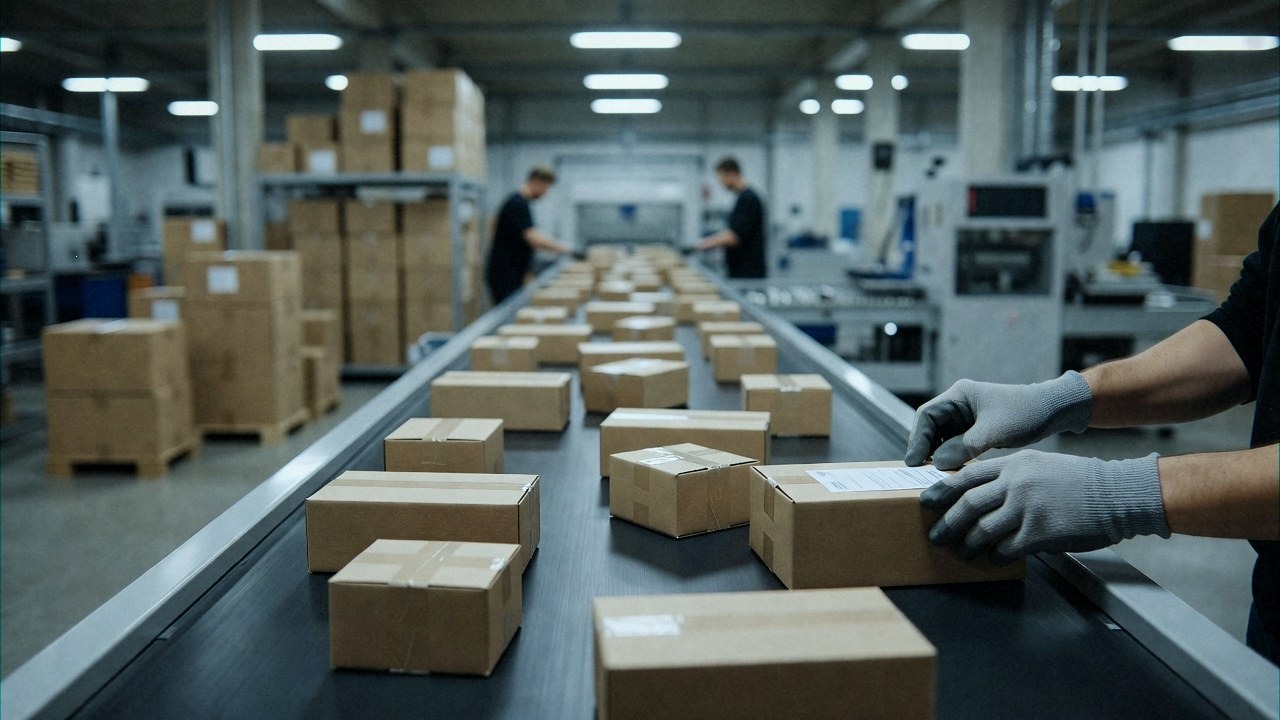
The clause that broke the shop
The part that emptied the shipping list is not the recyclability target or the reuse quota. It is extended producer responsibility.
Under PPWR, the producer is whoever first places packaged goods on a national market, and that explicitly includes distance sellers. A webshop in Leuven shipping to a customer in Lyon is placing packaging on the French market. France therefore wants its registration, its reporting and its fee, and it wants them from an entity it can reach. Article 40 handles that reach: a seller established in one member state, or outside the EU, selling directly to consumers in another must appoint an authorised representative established in that destination country to carry the EPR duties.
There is no single EU register. There are national ones: LUCID in Germany, the ADEME registry and unique identifier in France, the Spanish producer register, CONAI in Italy, Fost Plus in Belgium. Each has its own definitions, data formats, deadlines and fee schedule.

The fixed cost is not the packaging fee. It is the representative. Commercial services charge somewhere between 300 and 1,500 euros per country per year as a retainer, before tonnage is counted. Multiply by the number of markets a small seller touches and the number stops being a compliance line and becomes a business model question.
The variable side is not trivial either. Published base rates for rigid recyclable plastic packaging run in the range of roughly 280 to 1,200 euros per tonne depending on the scheme, and difficult or mixed plastics can exceed 1,400 euros per tonne. Paper and board sit far lower, in the low hundreds per tonne in most schemes. Eco-modulation sharpens the spread: better recyclability earns a discount, poor recyclability earns a malus. That is the mechanism working as designed, but it lands hardest on sellers whose margin is measured in cents per part.
What changed this summer is that the small-seller escape hatch closed. Belgium used to exempt producers below 300 kilograms of packaging a year. That exemption disappeared on 12 August 2026. The Netherlands, by contrast, still only requires registration above 50 tonnes, which is why the Dutch border stayed open for a shop shipping a few kilos annually. Two neighbouring countries, two radically different answers to the same regulation, and a seller obliged to know both.

Marketplaces have already built the enforcement layer the regulators have not. Amazon, eBay and Etsy run automated checks against national registration numbers. A missing LUCID number or French unique identifier does not produce a polite letter, it suppresses listings and suspends ASINs in that territory. Third-party logistics providers, classified as economic operators, increasingly refuse to onboard stock without authenticated EPR documentation. The compliance gate is not at the border. It is at the fulfilment centre and the seller dashboard.
The correction nobody should mistake for a fix
The Commission saw the damage and moved. Its environmental omnibus package, procedure 2025/0395(COD), proposes suspending the mandatory cross-border authorised representative requirement for EU-established producers until 1 January 2035.
On 5 October 2026 the European Parliament's environment committee backed the idea, but narrowed it. The suspension would cover micro and small enterprises established in the EU. It would not cover third-country sellers, who would still need a representative in each market. The plenary vote is due on 20 October, after which the Council must agree, and the Council is not of one mind. Germany, Ireland, Sweden and the Netherlands have argued for relief on intra-EU trade. France, Spain and Italy worry that relaxing the requirement without an automated cross-border enforcement tool invites free-riding and leaves national schemes short of revenue.
The Commissioner's framing is worth quoting in substance: this is red-tape relief and a survival valve, not an exemption from paying local waste fees. Small sellers would still pay. They would just stop paying retainers to intermediaries in 26 countries.
That distinction is honest and it is also the weak point. If the fees remain and only the paperwork is suspended, the economics of shipping to a market that yields 320 euros a year across ten countries do not change much. What changes is the legal risk of non-compliance during the gap.
And there is a gap. PPWR has applied since 12 August 2026. The amendment suspending the representative duty is still in the legislature. National authorities could in theory penalise a small seller for failing to appoint representatives during the intervening months, while the political class agrees that the obligation was a mistake. Enforcement discretion is doing work that legislation should be doing, and discretion is not something a business can put in a spreadsheet.
The bigger prize, if it arrives, is the Circular Economy Act expected in late 2026. Industry bodies such as Eurochambres, SMEunited and EuroCommerce are pushing for a single EU registration portal that would route volume data and settlement fees to national schemes, plus a harmonised eco-modulation framework so a package is not rewarded in one country and penalised in another. That would address the actual defect. PPWR harmonised the standard and left the administration fragmented.
What this means for the European market
Four effects are already visible, and they will outlast whichever version of the omnibus passes.
The first is consolidation through fixed costs. A large seller absorbs 20,000 euros of annual compliance across the single market without blinking. A micro-seller cannot. The result is not that packaging waste disappears, it is that the seller disappears, and the volume migrates to someone with a compliance department. Brussels calls this professionalisation. An economist would call it a regulatory barrier to entry with a green label.
The second is geoblocking inside the single market. The regulation's stated purpose is to make cross-border trade work under one rulebook. Its administrative layer is producing the opposite: sellers disabling whole countries in their shipping settings because the expected revenue does not cover the fixed cost of being allowed to sell there. The single market is not being broken by tariffs. It is being broken by registration forms.
The third is an enforcement asymmetry that runs the wrong way. EU micro-sellers face suspension for a missing number while third-country sellers shipping small parcels through postal networks can remain effectively invisible to national registries. The European National Registers for Packaging has pointed out that the current debate is one-sided: the omnibus relief, as drafted by the Commission, would also have benefited sellers outside the EU, while the parliamentary version confines relief to EU companies. Either way, the seller inside the union carries a burden the seller outside it can avoid. That is not environmental policy, it is a competitive handicap.
The fourth is design pressure transmitted up the supply chain. Eco-modulated fees and the 2030 recyclability threshold turn packaging specification into a procurement decision with a visible price. Brands will renegotiate with converters, converters will consolidate around materials that can hit grade C or better at scale, and difficult laminates will get expensive before they get banned. This is probably the most durable and least discussed part of PPWR: it is an industrial policy for packaging materials disguised as a waste directive.
The unresolved contradiction sits in reuse. PPWR sets binding reuse and refill quotas from 2030, but there is no interoperable European deposit-return system, no standardised cross-border washing logistics and no return network for e-commerce packaging. Targets have been written before the infrastructure exists. Either the infrastructure arrives in three years, or the quotas become a compliance fiction with a documented exemption trail.

Three dates to watch
The plenary vote on 20 October decides whether the relief survives in a form that helps anyone. The Council then decides whether it becomes law before national authorities start enforcing the original text in earnest. And the Circular Economy Act, expected in November, decides whether Europe moves to one registration portal or keeps 27.
For the seller in Belgium, none of this arrives in time for the fourth quarter. He has set a minimum order value, changed his terms, cut 25 countries and given himself until December to see whether the smaller footprint can carry the shop. If it cannot, a five-year-old business closes and a few thousand LEGO builders lose a supplier who knew exactly which part they needed.
That is not a statistic. But multiply it across ceramics, vinyl records, spare parts, second-hand books and every other micro-export business in the union, and it becomes one.
Sources
- Regulation (EU) 2025/40 on packaging and packaging waste, EUR-Lex
- European Parliamentary Research Service, briefing on suspending authorised-representative rules for extended producer responsibility, 12 October 2026
- European Parliament Legislative Observatory, procedure 2025/0395(COD), environmental omnibus
- European Parliament ENVI committee vote on draft reports, 5 October 2026
- Packaging Insights, EU Parliament committee backs EPR reprieve for SME packaging, October 2026
- Zentrale Stelle Verpackungsregister, LUCID registry guidance
- Citeo, Ecoembes, CONAI and Fost Plus published fee schedules
- Eurochambres and EuroCommerce positions on the Circular Economy Act and EPR single market reform
About the Author







Obligatory disclosure: I write on finance.go4them.co.uk, so my bias is that I read every regulation as a P&L line item first and a policy second and I’ve been banging on for a while that compliance cost is the most underrated moat in European small business. This piece is basically that thesis wearing a LEGO minifig hat, and I mean that as a compliment.
The single most damning number here isn’t the packaging fee, it’s the 175 EUR Belgian registration before a single gram is even counted. That’s not a fee, that’s a subscription to be allowed to exist. Netflix costs less and has better content. And the France line 16 orders, 945 EUR over twelve months 16 orders. I’ve had group chats that lasted longer than that. “Do the arithmetic,” the article says. The arithmetic is the article.
What gets me is that this is textbook fixed-cost barrier to entry and everyone in Brussels knows it. Split a fixed cost across volume and whoever has volume wins; the micro-seller’s marginal order is profitable and their full-compliance order is not. Compliance departments are just economies of scale in a hi-vis vest. Every SME screaming “we can’t afford this” and every consultant whispering “professionalisation” are describing the same graph from opposite ends.
The best line in the whole piece is “the single market is not being broken by tariffs, it is being broken by registration forms” that one’s going in my notes, and honestly today’s plenary vote in Strasbourg is the boring version of the same fight the bond market has been having all quarter: how much administrative friction can you stack on a transaction before the transaction stops happening? Also, capping empty space at 50% is the first EU rule my Amazon deliveries have personally campaigned for. My last order was a single cable in a box built for a microwave, and I assume the packaging was 90% air and 10% existential dread.
Small prediction for whoever’s betting on the omnibus: the representative duty gets suspended, the fees do not, and the fee is the part that actually killed the shop. Suspending paperwork while leaving a per-country bill is like letting me into the club for free and charging me for the coat check, the bathroom and the oxygen.
Genuine question for the cross-border sellers in here: at what annual revenue per country do you personally decide a market is worth the paperwork? I’ve been using roughly 2,000 EUR as a rule of thumb and I’d love to know if that’s too stingy or too generous.
EDIT: someone upthread asked about a cheap gaming laptop for admin work and the odd game between packing orders the Lenovo IdeaPad Gaming 3 is what I keep telling people who don’t want to think too hard about it. Picked one up through the SYNTEO folks at gamdroid.eu, and it cost less than a single country’s authorised-representative retainer, which is a genuinely depressing unit of comparison.
Alex here, and I need you to know I read this twice once as a reader, and once as someone who has done this exact arithmetic on the back of an invoice at one in the morning with a mug going cold beside the keyboard. That line, “he is the edge case that turns out to be the rule,” has been rattling around my head for twenty minutes like a coin in a dryer. It’s the kind of sentence that makes me want to argue with you and buy you a drink in the same breath, which I suspect is the whole point of how you write.
Confession, and then a question. I run a two-person operation selling spare parts into six markets, and last spring I spent an entire Sunday reconciling a German volume report against a French unique identifier for a year in which my total packaging weight was under two hundred kilos. The paperwork outweighed the cardboard. That is the part nobody outside this niche believes until they’ve lived it: the fee is not the wound, the fixed cost of being allowed to exist in a market is the wound, and the wound compounds because every register speaks its own dialect of the same language. You wrote that PPWR harmonised the standard and left the administration fragmented, and I felt that somewhere behind my sternum. I want to be a good actor here. I want my boxes to be recyclable and my volumes reported honestly. What I don’t want is to feel like honesty has a subscription price per country.
What genuinely unsettles me and I mean this as admiration, not complaint is how cleanly you exposed the gap between the law and the discretion filling in for it. Industrial policy wearing the clothes of a waste directive. Sellers disabling whole countries in their shipping settings, not because of tariffs but because of forms. The single market broken by registration portals rather than borders. Every one of those is a sentence I’m going to be quoting at people who assume “regulation” means “someone checked.” And “discretion is not something a business can put in a spreadsheet” that one I’m stealing outright. I’ve watched a fulfilment partner refuse stock over a missing number while a parcel from outside the union sails through untouched, and the asymmetry you describe is exactly the shape of the thing I couldn’t articulate.
Small aside for anyone else running a one-room operation out of a spare bedroom: I finally replaced the flickering hand-me-down screen over my packing bench with the Samsung LT24E310 SolGrunt had it, I spotted the listing on smartphonesoutions.eu and a 24-inch LED is honestly all this kind of work needs. It runs cool, it doesn’t eat half the desk, and the part number is legible when you’re squinting at it at midnight. Not glamorous. Just correct. Which, come to think of it, is the standard this whole article is holding everyone to.
So here’s what I actually want to ask you, and I’d love your honest read rather than the diplomatic one: if the omnibus passes in that narrowed ENVI form, does it change the arithmetic for a micro-seller at all or does it just move the cliff edge a few metres back and give everyone a nicer view of it? Because from where I’m sitting, relieving me of a 300-euro retainer while leaving the fee, the reporting and the twenty-seven registers intact feels less like a rescue and more like being handed a smaller anchor. I’d genuinely like to be wrong about that. Convince me.
Either way, I’ll be here for whatever you write on the Circular Economy Act in November and I mean that selfishly, because I’d rather read your prose about a registration portal than anyone else’s. You have a way of making compliance sound like a thriller, and I’m not entirely sure that’s a compliment, but I mean it as one.