
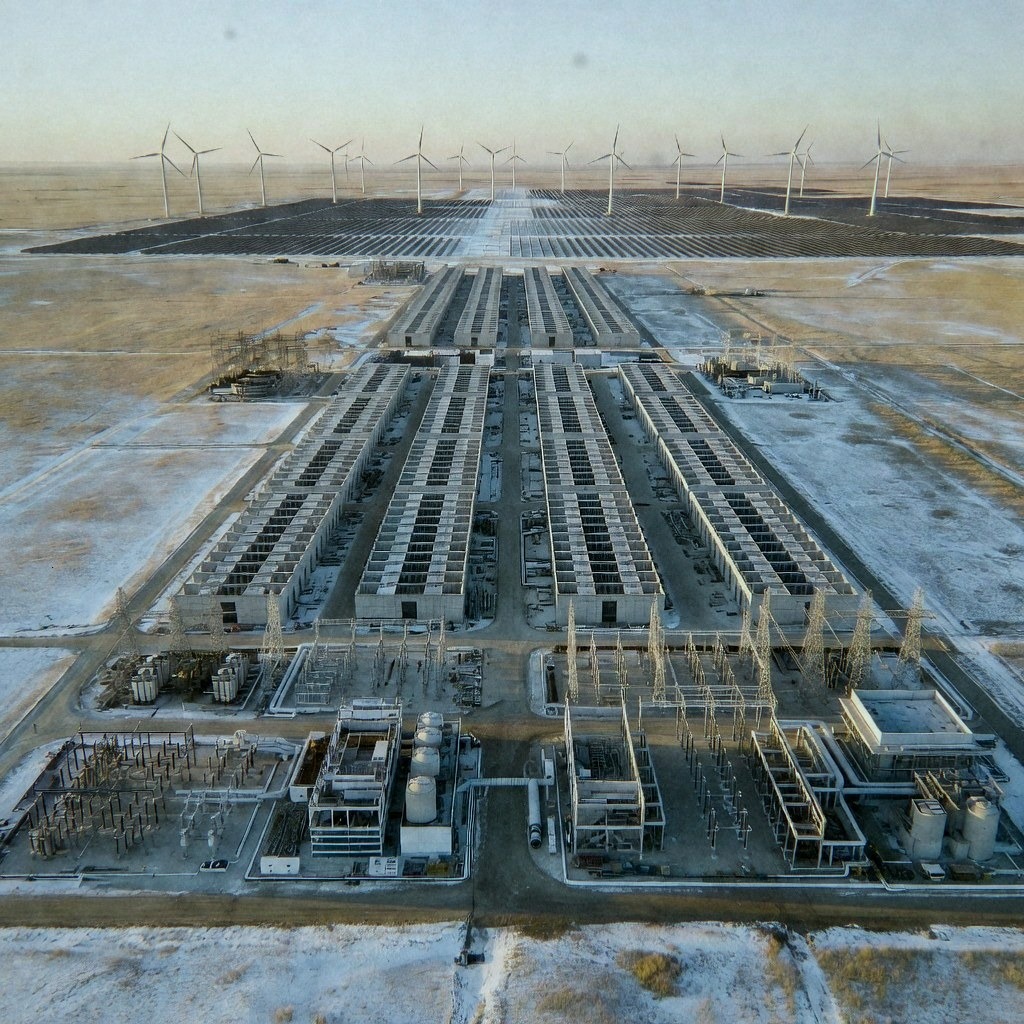
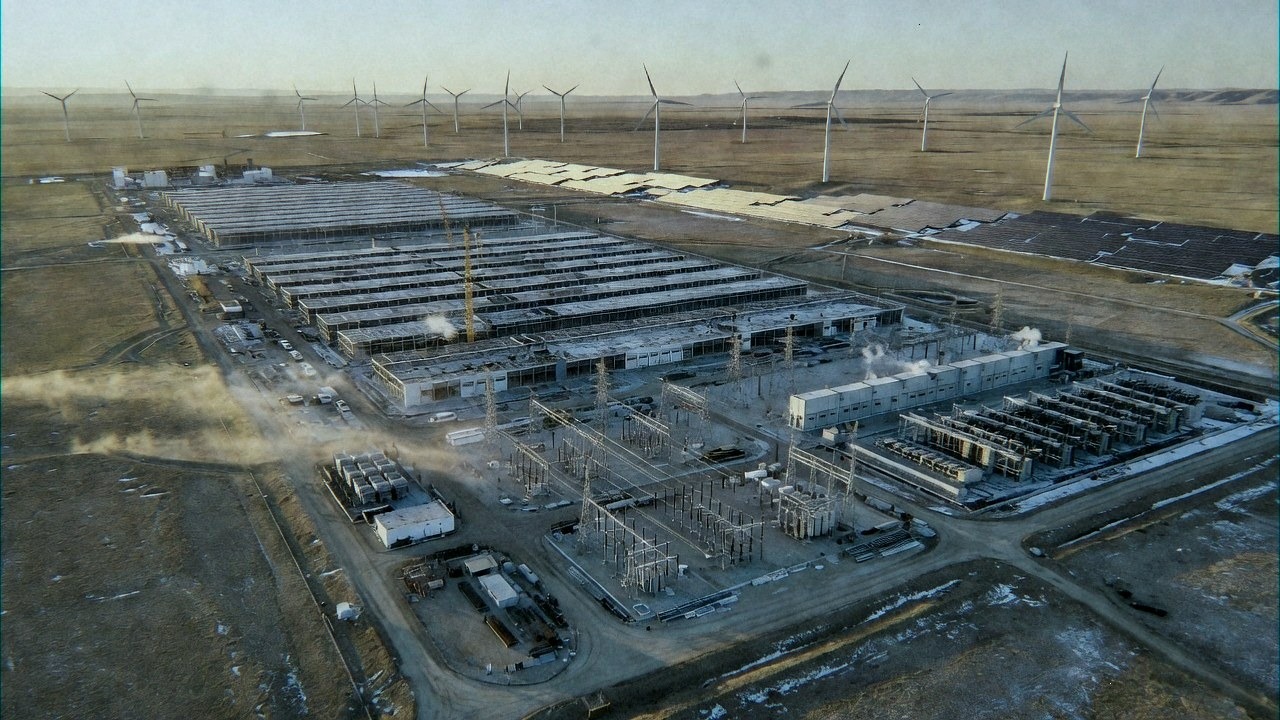
In the desert outside Hohhot, and in the grasslands around Ulanqab, satellite images show the outlines of something the world has never built at this speed before. Walled campuses the size of small towns. Substations. Cooling plants. Row after row of halls designed to hold tens of thousands of processors, each one burning electricity the way a steel mill burns coal.
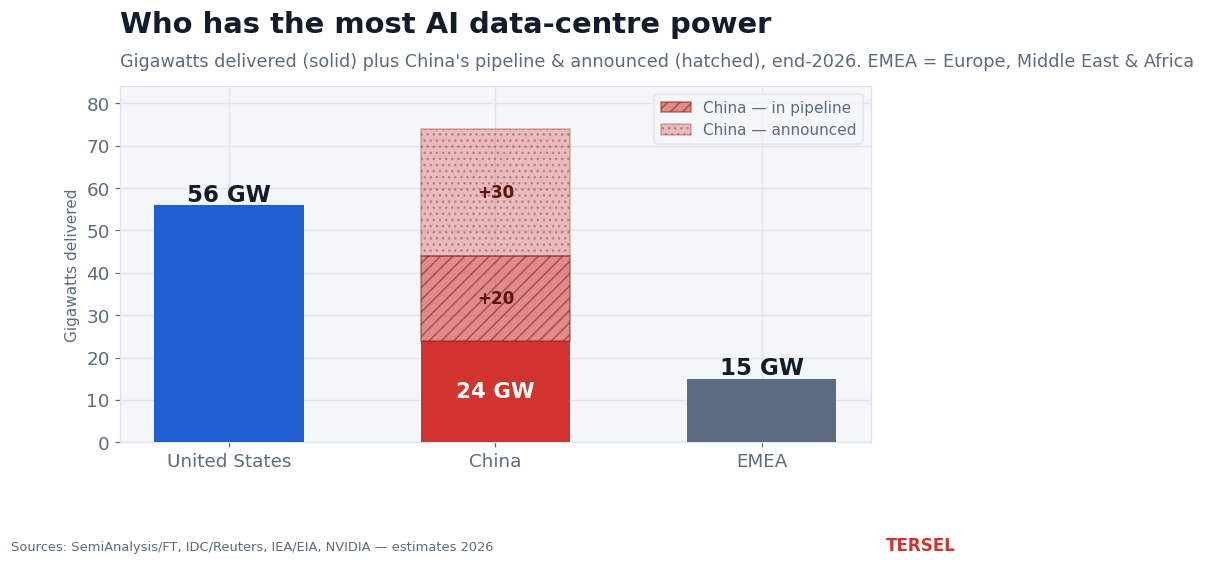
China now runs more than a thousand data-centre facilities, with a fleet that has passed 30 gigawatts of capacity and another 20 gigawatts under development. The United States is still the larger market, heading for around 60 gigawatts by the end of the year, but the gap is closing faster than most analysts expected. Europe, the Middle East and Africa combined have roughly 15 gigawatts. China alone is building toward more than twice that.
The numbers are impressive. They are also, on their own, deeply misleading. Because the buildings are not the hard part.
The scale, in one chart
Strip away the announcements and the picture is cleaner. By the end of 2026, the United States has roughly 56 gigawatts of delivered data-centre capacity, China about 24, and Europe, the Middle East and Africa around 15. China's pipeline adds 20 more, and another 30 gigawatts sit in announced projects, most of them in the interior.
What makes the Chinese build-out different is not just size but speed. A 100 megawatt campus, the kind that would take years of permitting in the West, can go from bare ground to running servers in under twelve months. Crews prepare the site while suppliers assemble the electrical and cooling gear into factory-built modules offshore. The modules arrive ready to bolt in and connect. Local governments line up land, financing and grid access in parallel rather than in sequence.
There is also a force that rarely gets named. Fear of missing out between provinces. When one region lands an AI campus, its neighbours rush to offer cheaper land, cheaper electricity and faster approvals, because they know that if the investment goes elsewhere, so do the jobs. Multiply that competition across a dozen provinces and you get a land rush.
The map behind the boom
Beijing, Shanghai and Shenzhen generate enormous amounts of data. They also have the most expensive land and power in the country. So the plan, which China calls Eastern Data, Western Compute, moves the energy-hungry work to where electricity is cheap and space is abundant, while keeping the services that need a fast response close to users. The two halves are stitched together with high-speed fibre.
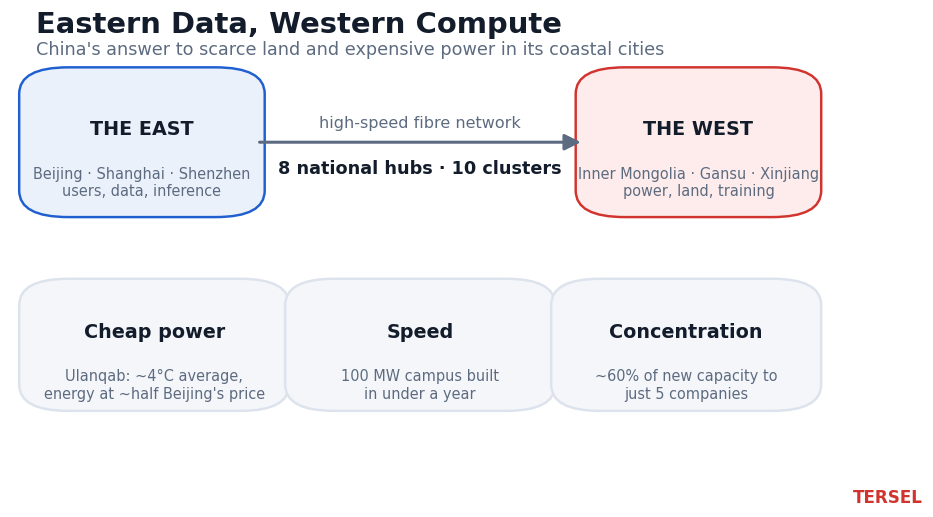
The plan spans eight national computing hubs and ten clusters. Walk northwest from Shanghai toward Inner Mongolia and the scale becomes concrete. Ulanqab alone has signed agreements for close to 19 data-centre projects, with planned capacity of around 12.5 gigawatts, more than ten times what the city operated a year earlier. ByteDance, the company behind TikTok and CapCut, is expanding heavily there. Huawei and Alibaba are present too. Near Hohhot, more than 30 data centres were reported under construction inside a three-kilometre radius.
The logic is simple once you see it. Ulanqab's average annual temperature is about four degrees Celsius. For a data centre, that is a gift. Almost all the electricity that powers a compute tray turns into heat, some GPUs running near 80 degrees under load, so the colder the outside air, the cheaper it is to carry that heat away. Inner Mongolia also has vast solar and wind farms plus coal plants, and campuses there can pay roughly half what a facility in Beijing pays for power. Run thousands of chips around the clock and that difference becomes the whole business case.
The chips are the problem
Every one of those buildings needs processors, and this is where the story turns. Export controls have cut China off from the most advanced Nvidia accelerators and from the equipment needed to make cutting-edge chips. That vacuum is the reason Huawei now sits at the centre of the story.
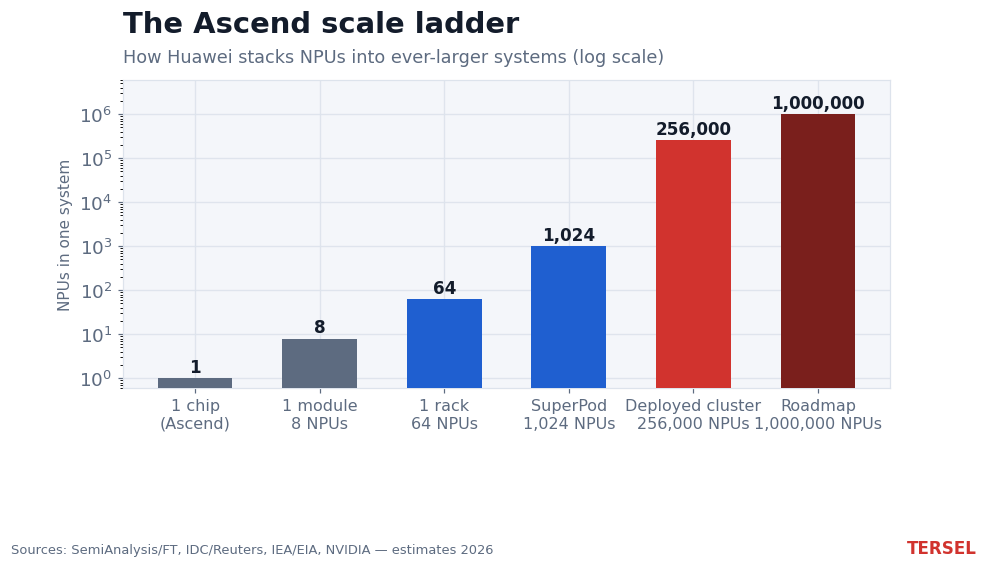
Huawei's AI processor is not a GPU but an NPU, a neural processing unit. The company stacks eight of them into a compute module, eight modules into a rack, and sixteen racks into a 1,024-NPU SuperPod. Link several of those and, Huawei says, you get systems already being deployed with 256,000 NPUs, with a roadmap pointing at a million.
Getting thousands of fast chips to work as one machine is the real test, and it is the part that interested me most in the company's Shanghai disclosures. Huawei has built an optical engine it calls Hi-ONE, which sits close enough to the electronics that data travels a short distance electrically before being converted into light and sent down fibre. It is the same near-packaged-optics approach that much of Silicon Valley is racing to build. At high data rates, copper gets harder and more power-hungry to push, and Huawei claims its design cuts communication power by more than half a megawatt per SuperPod, power that is then free for actual AI work.
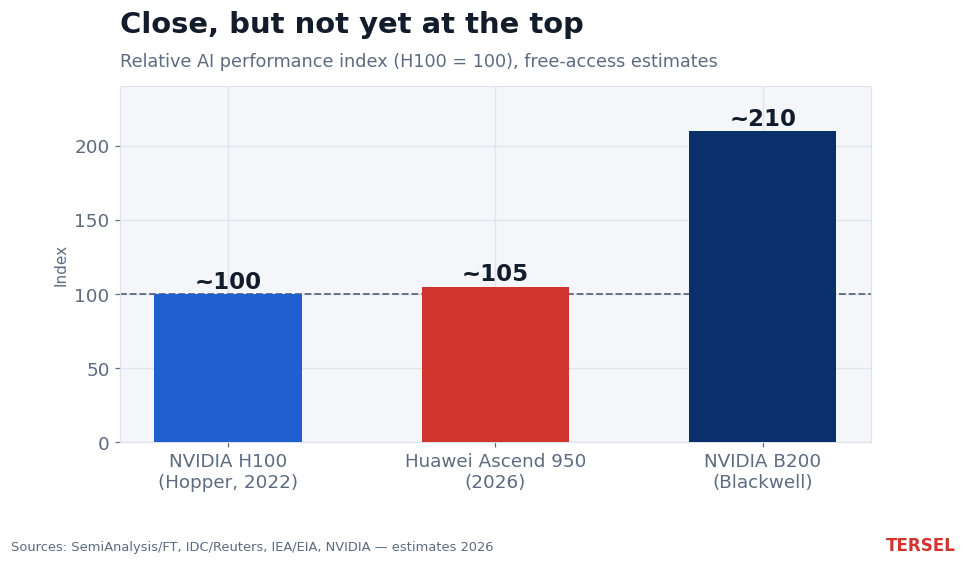
How does it compare with Nvidia? Fairly, but not favourably at the very top. Independent estimates put Huawei's latest chip broadly at parity with Nvidia's H100 generation for training and inference, and roughly two times behind the newer Blackwell parts. Closing that gap is the whole game.
The market has already flipped
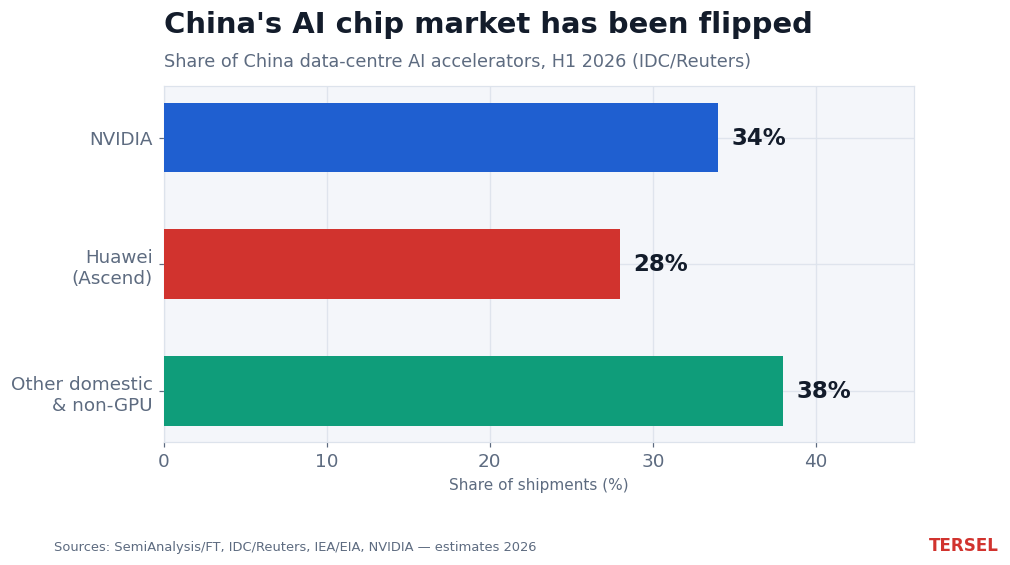
The most striking number in this story is not about buildings at all. It is about who is selling the chips inside them. According to IDC data reported by Reuters on 13 October 2026, Nvidia's share of China's data-centre AI accelerator market fell to 34 percent in the first half of the year, while Huawei climbed to 28 percent after shipping around 572,000 chips. For the first time, non-GPU accelerators outsold graphics processors by volume in China.
Software is the next front. Nvidia's real moat has never been the silicon alone but CUDA, the programming platform and library ecosystem that entire companies are built on. Replacing the chip is only step one. The harder question is whether existing code runs on the replacement. That is why DeepSeek and Huawei open-sourced TileLang, a language that lets engineers write one piece of code and run it on both Nvidia GPUs and Huawei's Ascend chips. CUDA still matters enormously, but it is no longer the only route to fast AI, and that alone changes the negotiating position of every buyer in China.
Where the ceiling sits
Supply, not demand, is now the binding constraint. Even Huawei reportedly cannot make enough AI hardware to fill the halls China is building. The bottleneck begins inside the factories.
SMIC, China's leading foundry, reported its plants running at almost 95 percent of capacity in the second quarter of 2026, and it is expanding in Beijing, Shanghai, Shenzhen and Tianjin. But a new factory is only part of the answer. China cannot buy ASML's extreme ultraviolet machines, the tools that print the smallest features of the most advanced chips. Manufacturers compensate by pushing older deep-ultraviolet equipment harder, using extra patterning steps to draw ever-smaller features in several carefully aligned passes. It can work, but every extra step adds time, cost and another chance for something to go wrong. Yields on the most advanced domestic lines remain well below what a leading-edge fab would accept.
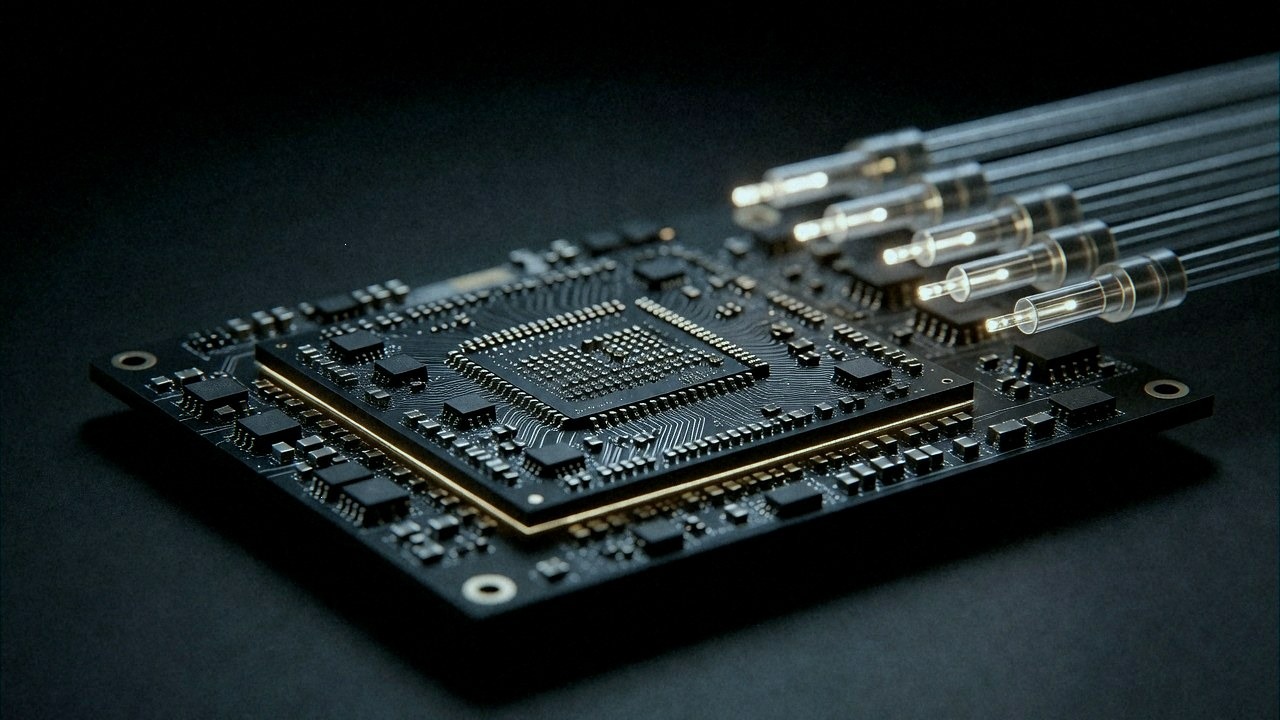
Then there is memory. AI chips are useless without high-bandwidth memory to feed them fast enough, and HBM is made by stacking multiple memory dies and wiring them with microscopic pathways, a process that demands specialised tools and deep know-how. Chinese memory makers such as CXMT in Hefei are ramping up. Huawei has announced its own HBM designs, HiBL 1.0 and HiZQ 2.0, for its newest chips. But memory and processor production have to grow together, or you solve one shortage only to run straight into the next.
At a round table in Shanghai, one forecast put global supply and demand into balance around 2029 and China's around 2030. Those are estimates, not deadlines, and the demand curve keeps moving.
Two economies, one bet
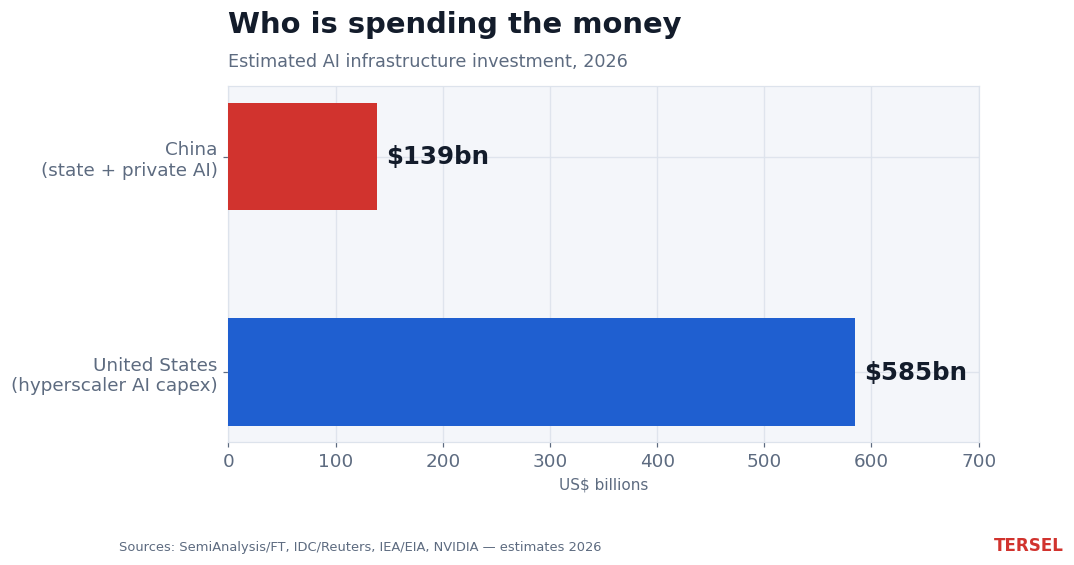
The economic asymmetry is the part that should worry planners in both capitals. The United States is spending far more money, an estimated 585 billion dollars of hyperscaler AI capital expenditure in 2026 against China's roughly 139 billion. But money is not the only currency. China is bringing power, land and construction speed, and it is doing so while growing at around 4.5 percent against America's 2.3.
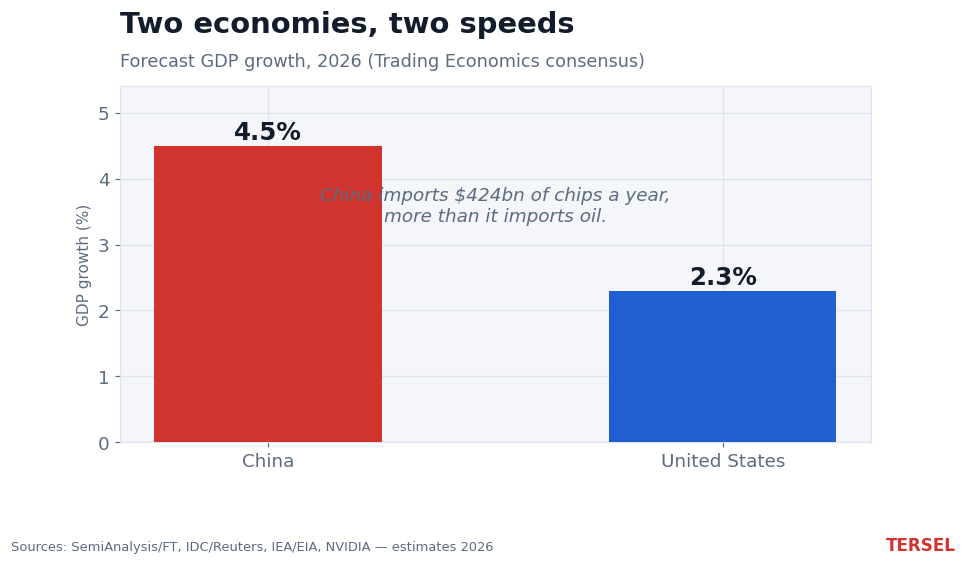
There is a deeper dependency underneath. China imports roughly 424 billion dollars of integrated circuits a year, more than it spends on oil. An AI boom built on imported silicon is a boom with a foreign policy attached to it. Every gigawatt of capacity that comes online increases the pressure to substitute domestic chips, and every export control tightens that pressure further. The result is a race in which the United States is trying to slow China down without slowing down its own suppliers, and China is trying to catch a moving target it cannot see.
The geopolitical bill
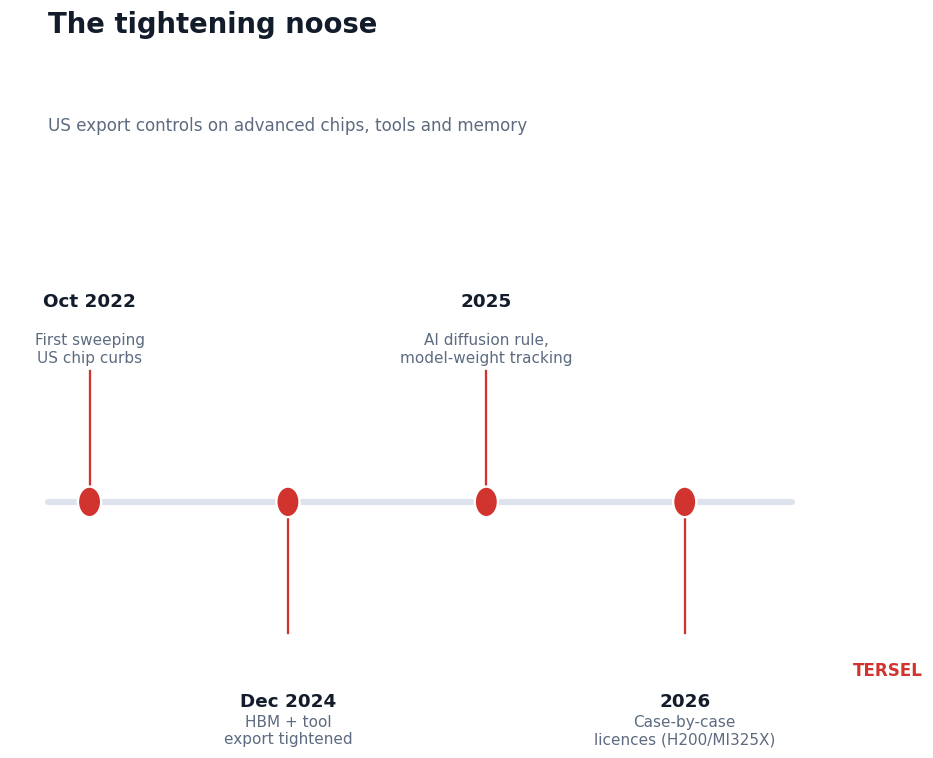
The controls themselves have a history, and it is a tightening one. Sweeping curbs in October 2022 were followed by restrictions on memory and tooling, then by rules on AI diffusion and model weights, and then by case-by-case licences that make every advanced accelerator a political decision. Each round has pushed China's domestic industry further and made the eventual substitution more likely, even as it raised the cost of getting there.
The single most dangerous dependency is not in China at all. Taiwan's TSMC commands more than 85 percent of advanced AI logic manufacturing and close to all of the advanced packaging capacity the industry depends on. That concentration is why every AI roadmap on earth, American and Chinese alike, is one bad quarter in the Taiwan Strait away from a crisis. It is also why the alliance response has been to subsidise fabs onshore, from Arizona to Japan, at a cost that will take a decade to show up in the numbers.
If China does pull this off, the consequences run through both economies. The American advantage in AI has rested on three things, the best chips, the deepest software ecosystem and the cheapest capital. Two of those are being eroded at the margins: the software moat is being challenged by open, portable tooling, and the chip lead is narrowing in the one market that matters most for volume. What remains is capital, and capital follows returns, not flags.
There is also the question of who these machines serve. Around 60 percent of China's new data-centre capacity will go to just five companies: ByteDance, Alibaba, Tencent, Baidu and Huawei. Recommenders, video generation, cloud services, and the quiet scoring of hundreds of millions of people. That is the part of this story that is not about geopolitics at all, and it may matter more than any of it. The build-out will make AI tools cheaper and more plentiful everywhere. It will also concentrate the systems that decide what people see in a handful of hands, and put the answer to who owns your data inside a jurisdiction that is not yours.
What to watch
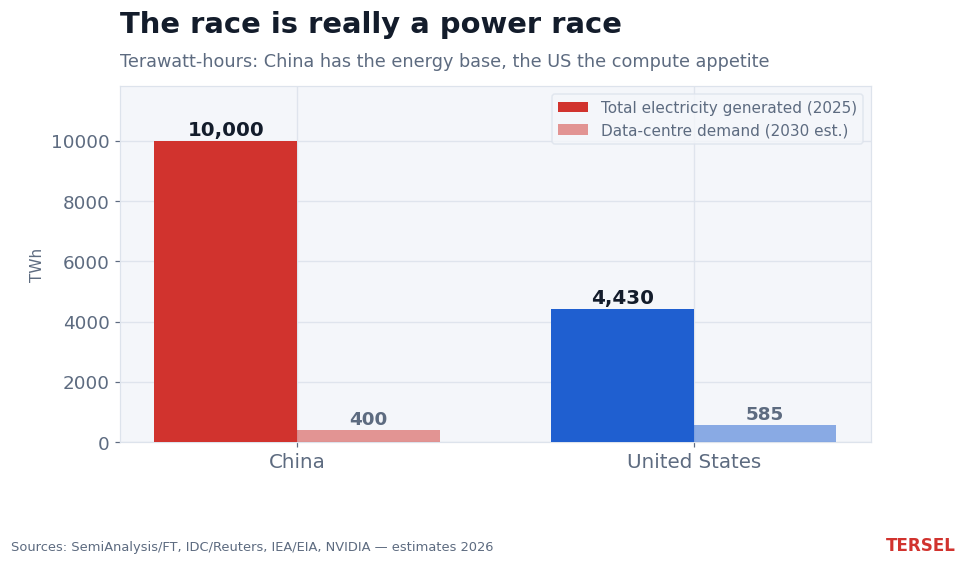
Three things will decide how this ends. First, yields. If Chinese foundries can lift advanced-node output, the chip gap closes faster than the buildings suggest. Second, software. If portable tooling like TileLang gains traction, Nvidia's moat erodes from below, chip by chip. Third, power. China has the energy base, roughly 10,000 terawatt-hours of generation against America's 4,430, but the grid that feeds its interior campuses is the same grid that has to keep the lights on for everyone else.
The buildings went up in a year. The chips will take a decade. Whoever wins the race is not the country that builds the fastest, but the one that can keep the machines fed, and that fight is only just beginning. It is the same competition I traced when I wrote about how the rules-based order collapsed into multipolar rivalry and about the chokepoints that decide who controls trade. Compute is simply the newest one, and the hardest to blockade.
Source: Anastasi In Tech, China Just Built What NVIDIA Feared Most. I Saw It (October 2026), with additional reporting from IDC via Reuters, SemiAnalysis via the Financial Times, the IEA and the EIA.












Leave a Reply