GenBox Free Tools (genbox.eu)
China is not trying to win the AI race
On 8 November 2026 Nvidia confirmed that its board had opened an investigation into Jensen Huang, the chief executive who built the company into the most valuable firm in the world, over a relationship with a businesswoman whom US intelligence services assess to be a Chinese asset. Huang has admitted the affair. Three Republican congressmen had demanded answers within days of the first New York Times report on 29 October. The company's shares moved, the cable shows filled, and the story was filed under espionage.
That filing is wrong, or at least incomplete. The affair may be real and the intelligence assessment may be correct, but neither explains the timing. What explains the timing is that Huang had spent the previous three months as the most effective political lobbyist in Washington for a position the American closed model industry cannot tolerate: that Chinese open weight models should not be banned.
To understand why that position is intolerable, and why the personal life of a chip executive became a national security matter, you have to look past the spy story to the thing underneath it. The AI race is no longer a race for the best model. It is a fight over whether intelligence will be sold by the token or distributed like electricity, and over what happens to several trillion dollars of capital if the answer is the second one.
What is actually being sold
Almost everyone who uses AI today is renting. A prompt goes to a data centre owned by somebody else, a model answers, and the user pays per token under terms that the provider can change, price up, or withdraw. The weights, the numbers that constitute the model, never leave the building. This is a normal software business: high fixed cost, near zero marginal cost, and pricing power protected by the fact that the customer has nowhere else to go.
The alternative is to publish the weights. Anyone can download them, run them on their own hardware, modify them, and never pay a licence fee again. The marginal cost of a query then falls to the price of electricity and depreciation on hardware the user already owns. This is not a software business. It is a utility business.
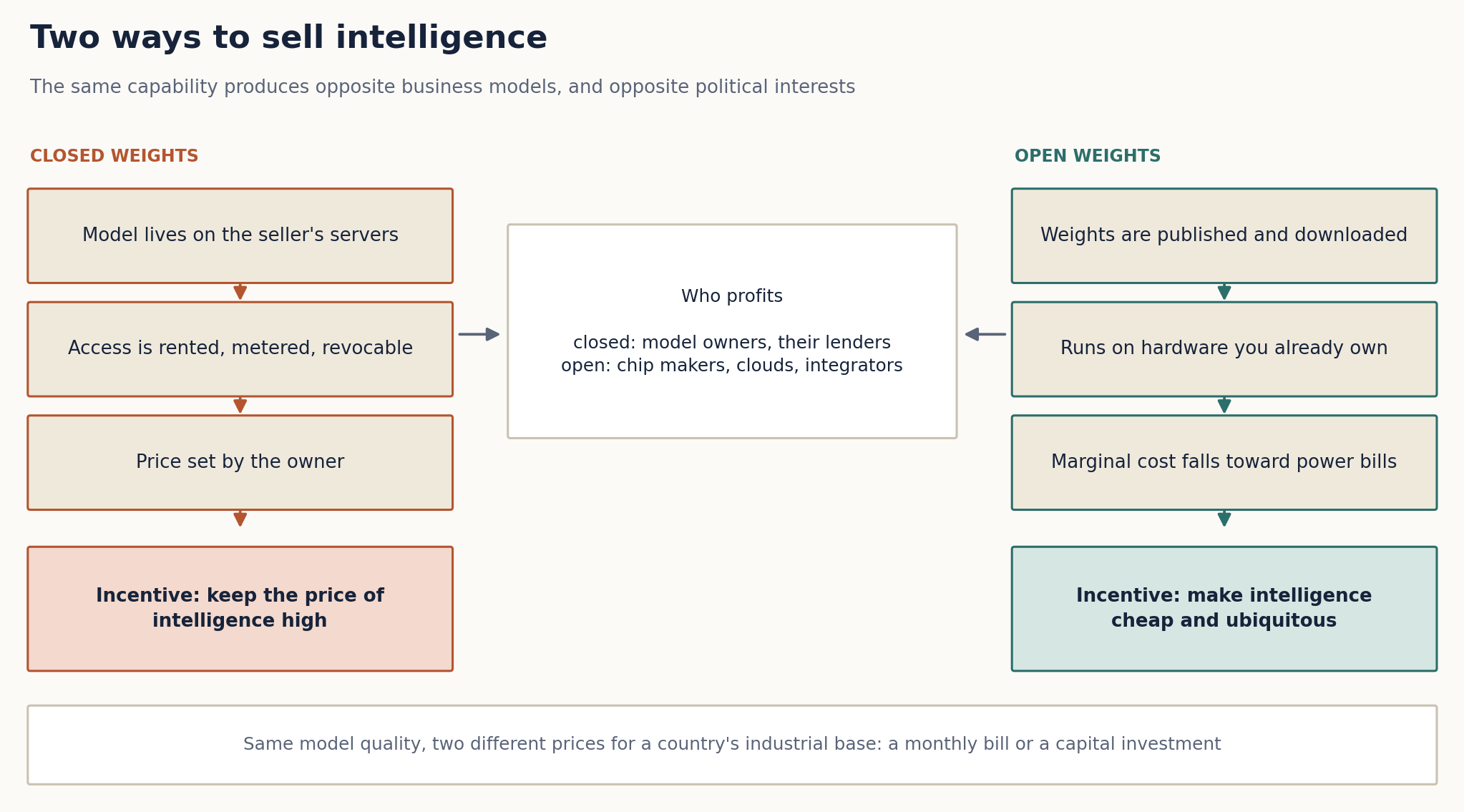
Two ways to sell the same capability, and why the incentives diverge. Source: Tersel analysis.
The distinction matters because it determines who gets paid in the next decade. A company that sells model access needs intelligence to stay expensive. A company that sells chips, servers, cloud capacity or integration needs intelligence to become cheap and ubiquitous, because volume is its revenue. Nvidia does not earn a cent from model subscriptions. It earns from every additional workload in the world. That is why the company committed roughly 26 billion dollars over five years to building open models and giving them away, a figure disclosed in a 2025 financial filing and confirmed by executives this spring. Microsoft, Meta, Dell, IBM, Hugging Face and twenty others signed the same position in a letter to Washington on 24 July 2026 titled “Open Weights and American AI Leadership”.
So the American industry is not united. It is split down the middle by business model, and the split maps almost perfectly onto the question of what to do about China.
Why Beijing gives away its best work
China cannot yet buy or build the most advanced lithography tools at scale. Export controls on high bandwidth memory and semiconductor manufacturing equipment have bitten, and the gap in leading edge fabrication is real. A country in that position has two options. It can try to outspend the incumbent at the layer it cannot reach, which is slow and expensive. Or it can destroy the economics of the layer above.
Beijing chose the second. Moonshot AI released Kimi K3 in July 2026, a 2.8 trillion parameter model with native vision and a million token context, published as open weights. It is not a charity release. It is a price signal. Industry measurements put open Chinese models within a few percentage points of the best American systems on many benchmarks at a small fraction of the cost per token, and the download numbers follow the price.
The mechanism is old and well documented. When the price of an input collapses, the rents built on top of that input collapse with it. American labs have raised and borrowed hundreds of billions on the assumption that they will one day charge for frontier intelligence the way Microsoft charged for Windows. If a model that is 90 to 95 per cent as good is available for nothing, that assumption stops being safe, and the debt raised against it becomes a problem for someone else.
Washington's response has been predictable. On 21 July 2026 Treasury Secretary Scott Bessent said the administration would examine Chinese open models for intellectual property theft and could sanction the companies behind them. “Open source is not open season on American IP,” he wrote, describing Chinese training practice as industrial distillation, a polite word, he said, for stealing. The New York Times reported that sanctions and trade bans were seriously under consideration. The labs pushing hardest for those restrictions were the ones whose revenue depends on intelligence staying expensive.
Then the other half of American industry pushed back, and won, at least temporarily. The July letter, Huang's first ever post on X, and Elon Musk's endorsement of it were enough to make the administration pause. Five months later the man who won that argument is under investigation over his contacts with China. It is possible that this is a coincidence. It is not a coincidence that makes for good strategy.
Five precedents, and where they break
History is not a lookup table, but it is useful for one thing: identifying which mechanisms recur when a state decides to give away the layer it cannot defend.
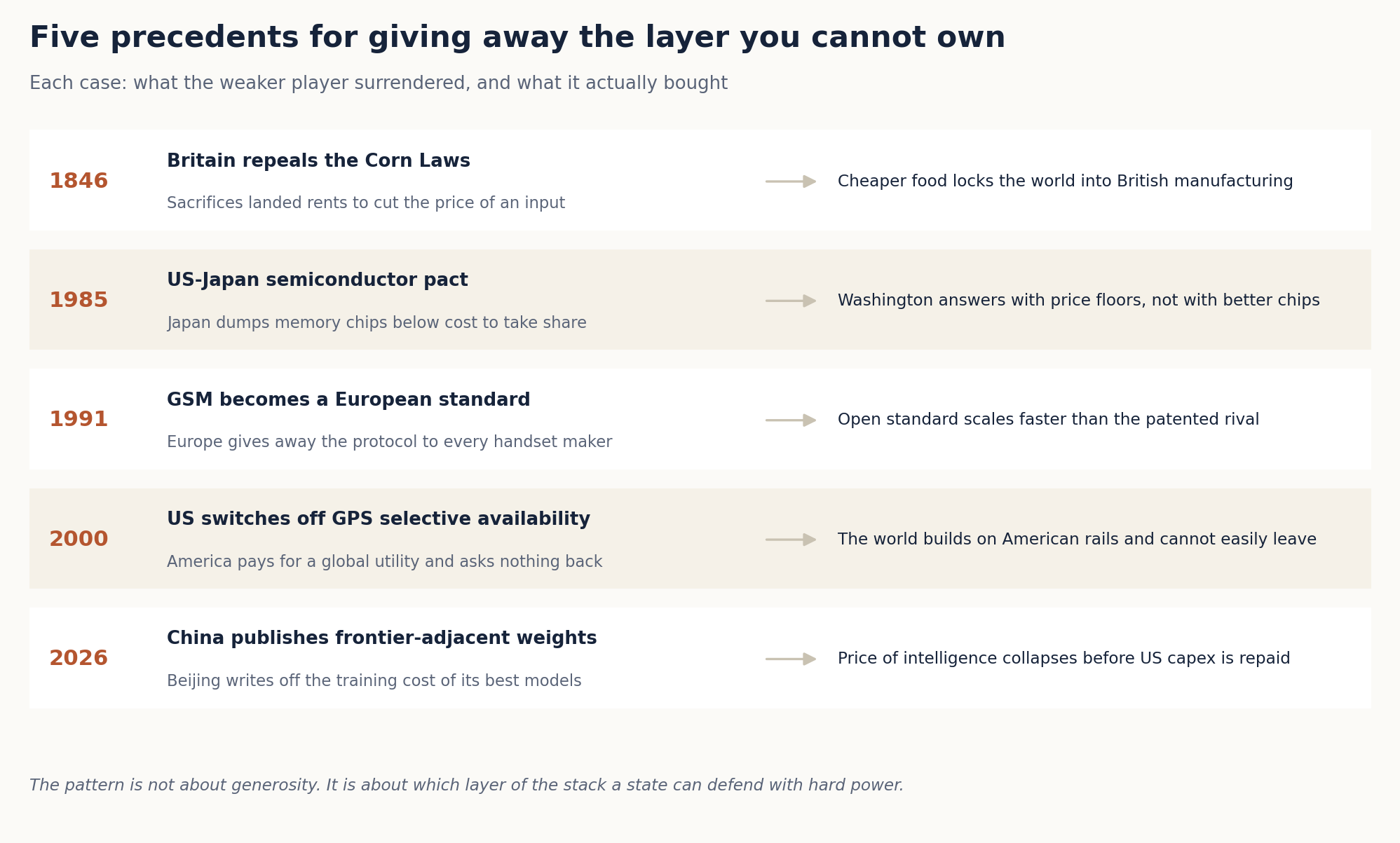
Five cases where a state or bloc surrendered a layer of the stack on purpose. Source: Tersel analysis.
Britain and the Corn Laws, 1846. Peel's government dismantled agricultural protection, sacrificing the rents of landed interests to cut the price of food for industrial workers. The result was cheaper inputs for British manufacturing and a trading system organised around British exports. The parallel is exact in structure: a state with an advantage in processing accepts losses at the input layer in order to dominate the layer above. It breaks in one place. Grain is rival and finite. Weights are neither, and they improve through use by outsiders.
The Opium Wars, 1839 to 1860. Britain ran a persistent silver deficit against China and reversed it by pushing an addictive commodity into a protected market. The mechanism was not military at first, it was balance of payments. The modern inversion is instructive: the United States now runs the deficit in physical goods and earns its surplus from services and intellectual property, which is why control of the model layer is a strategic rather than commercial question. The analogy breaks because intelligence is an input to production, not a consumable that degrades the buyer.
The US-Japan semiconductor conflict, 1985 to 1986. Japanese producers, backed by state coordinated capital, took memory market share by pricing below cost. Washington did not respond by building better memory. It responded with the 1986 trade agreement, price floors and market access quotas. Expect the same reflex now: administrative barriers, procurement rules and liability regimes rather than superior open models. The analogy breaks at the border. Memory chips passed through customs. Weights replicate across mirrors and torrents, and tariffs do not apply to a file.
GSM against CDMA, 1991 onward. Europe gave away a single open standard to every handset maker and beat a better engineered but proprietary American rival on scale. Openness won the network effect, and the licensed technology lost the market. This is the closest structural analogue to the current moment, and the one European readers should study. It breaks because GSM required spectrum allocation and carrier consensus, while model deployment requires only a server.
GPS, 2000. The United States switched off selective availability and gave the world a positioning utility for free, absorbing the cost of the constellation and asking nothing in return. The world built its logistics, aviation and agriculture on American rails. This is what a strategic public good looks like, and it is the model Beijing is imitating in reverse: absorb the training cost, let the world standardise on your weights, and accept that you will not be able to switch it off later. It breaks precisely there, because downloaded weights cannot be degraded by the issuer.
Two more belong in the margin. The Soviet Union cloned IBM's System/360 in the 1970s and saved the cost of designing a computer, then spent two decades permanently one iteration behind, which is the counter thesis to China's strategy and the reason to take the derivative critique seriously. Airbus, from 1970, shows the opposite: European states absorbed decades of losses and trade litigation to break a monopoly, because the alternative was permanent rent extraction by a single foreign supplier.
The money, which is the real subject
The espionage story is a political event. The financial architecture is the strategic one.
American hyperscalers spent roughly 200 to 220 billion dollars on capital expenditure in 2024 and guided toward 250 billion or more for 2025. A single 100,000 accelerator training cluster costs three to four billion dollars before the power contracts. The proposed gigawatt scale campuses are modelled at forty to fifty billion each. None of this is funded entirely from cash flow. A record share is being borrowed, and that borrowing competes with the United States Treasury for the same pool of lenders.
This is the part most commentary misses. There is only so much capital in the world willing to be lent at a given price. When a government sells bonds and a hyperscaler sells bonds into the same market, the price of borrowing rises for both. The AI companies can absorb higher rates because they believe the payoff is enormous. The government cannot, because it is refinancing trillions and its interest bill compounds. Treasury yields set the floor for mortgages, corporate credit and everything else, so the competition transmits directly into household costs.
Now add the second constraint. Roughly half of OECD tax revenue comes from taxes on labour, personal income tax and social contributions, while corporate income tax contributes somewhere between eight and twelve per cent. An economy whose tax base is human work has a structural interest in humans continuing to work in taxed roles. A technology whose explicit promise is the automation of cognitive labour is therefore a fiscal problem dressed as a productivity miracle.
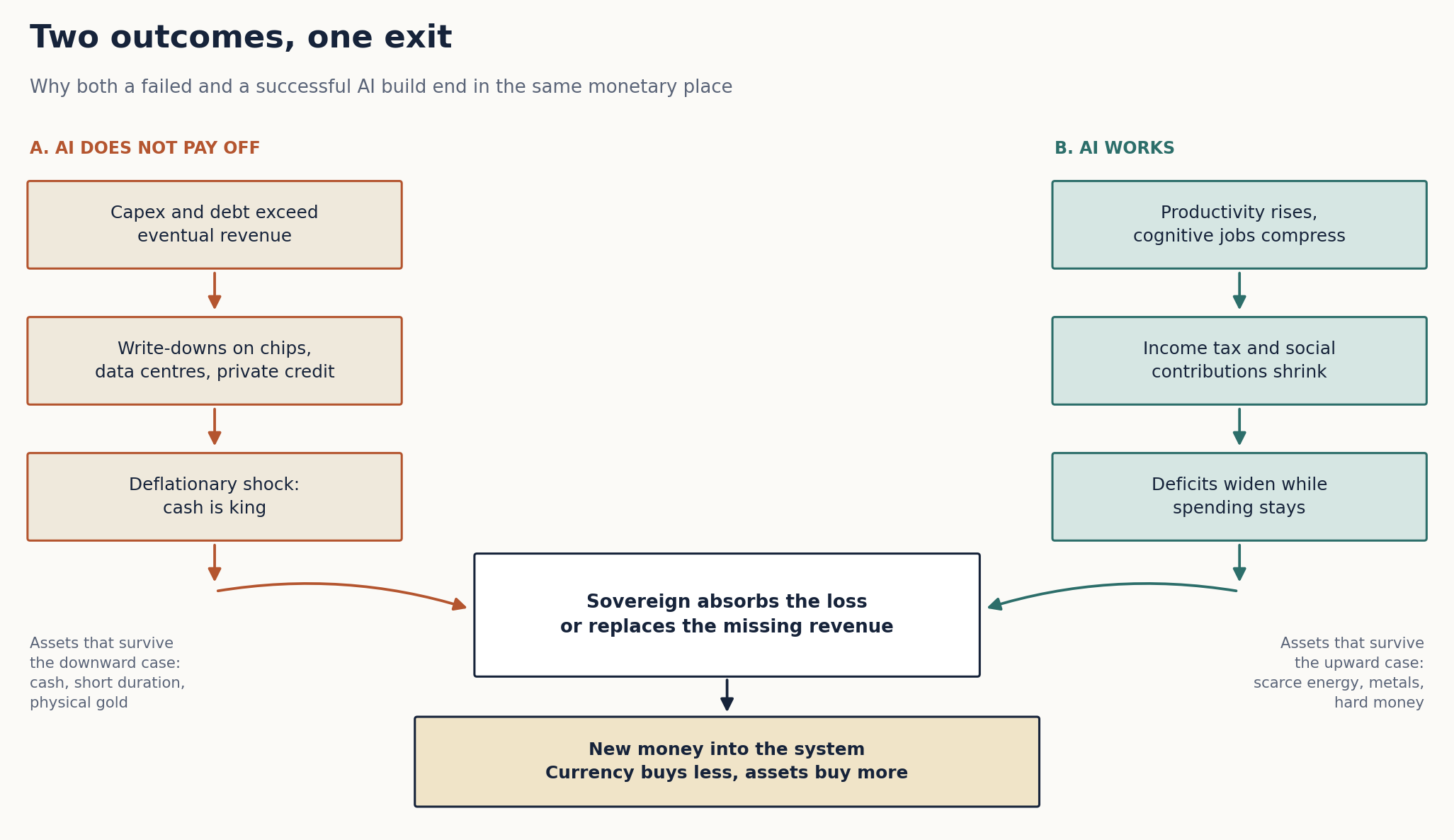
The fiscal channel. Both a failed and a successful AI build route through the sovereign balance sheet. Source: Tersel analysis.
Put the two together and the trap closes. If AI does not pay off, the debt raised against it impairs, private credit absorbs losses, and equity markets built on a handful of names rerate downward. If AI succeeds, the labour tax base erodes faster than new taxes on compute can replace it, while spending commitments remain. In the first case the state must rescue the balance sheets. In the second it must replace the missing revenue. In both cases the instrument is the same: new money.
This is the argument Luke Gromen has been making, and it deserves the attention it is getting. It is not a prediction about whether AI works. It is an observation that the political economy has removed the option of letting it fail, because too much of the retirement system, the credit market and the equity index now depends on it not failing.
The consequence is a choice between the currency and the technology. Most governments in this position choose the technology, because the currency has no constituency that votes and the technology has several.
Regulation as the fallback moat
If price competition cannot be won, the incumbent reflex is to change the rules. That is what the safety debate has quietly become.
The European Union's AI Act classifies models trained above 10^25 FLOPs as systemic and imposes evaluation, documentation and incident reporting obligations on them. The American debate has converged on the same instruments: mandatory pre-release testing, licensing thresholds, and liability for harm caused by a model's output. Each of these is defensible on its own merits. Each also has a predictable distributional effect.
A closed lab with a legal department, a compliance team and a policy office can absorb a licensing regime, because for it the regime is a fixed cost spread across a very large revenue base. An open source project that gives its work away has no revenue base at all. It cannot hire the lawyers, cannot fund the audit, and cannot insure the risk. Regulation that is neutral on its face is therefore not neutral in effect: it selects for the business model that can pay for compliance, and it does so while sounding like it is constraining that business model.
The irony is sharp. A safety regime designed to contain American labs would, if it lands as drafted, eliminate the only American counterweight to Chinese open weights, and hand Beijing the standards position it could not win commercially. Brussels has already run this experiment in other sectors. The AI Act may end up being the most effective industrial policy instrument ever written for a Chinese export.
Eight threads, one system
Read together, the AI story touches a set of threads that are usually analysed separately.
Compute sovereignty. A country that rents its intelligence from a foreign API has outsourced a function of government. Open weights allow air gapped deployment, local fine tuning and legal jurisdiction over the inference stack, at the price of adopting a foreign architecture. That trade is now being made by finance ministries from Jakarta to Nairobi, and it is being made on price.
Standards. Whoever defines what counts as a safe model defines who may sell one. The US has the standards bodies; China has the download numbers; Europe has the regulation and no frontier lab. All three are fighting over the same rulebook.
Export controls and their elasticity. Chip controls worked better than expected on hardware and worse than expected on outcomes, because they pushed Chinese labs into architectural efficiency. Distillation, mixture of experts routing and inference optimisation are all responses to a compute constraint. A constraint that produces efficiency gains is a constraint that eventually stops binding.
Energy. American electricity generation was roughly flat between 2004 and 2024, which is a remarkable fact about a country that grew its economy by a third over the same period. Data centre demand is projected to rise from about 200 TWh in 2022 toward 400 to 500 TWh by 2026, and interconnection queues in major markets run four to seven years. China builds ultra high voltage transmission as a matter of routine. The binding constraint on American AI may turn out to be a transformer, not a chip.
Debt and the currency. Covered above. The transmission from capex to yields to household budgets is the least discussed and most consequential channel.
Alliances. European industry needs cheap inference to stay competitive in cars, machinery and chemicals. It is being offered American cloud at American prices under American jurisdiction, and it is being told that Chinese weights are a security risk. Both statements are true, which is why the European position is incoherent and why it will be resolved by cost.
The Global South. A monthly API bill is a balance of payments item. A downloaded model is a capital investment. That is the entire pitch, and it is working. This is the Huawei playbook applied to software, with one difference: the recipient keeps a copy.
European regulation. Brussels wants to be the world's regulator while having no frontier model of its own. It can set rules for a market it does not supply, which works only as long as somebody else is willing to comply. The moment compliance costs exceed the value of European market access, the rules become a subsidy to whoever can afford them.
What Europe and Poland should take from this
The honest European reading is uncomfortable. There is no version of this contest in which Europe wins by training a frontier model from scratch. The capital depth is not there, the energy is not there, and the compute is not there.
What Europe has is an industrial base that consumes intelligence rather than sells it. For that base, deflation in the price of model access is unambiguously good news, in the same way that cheap container shipping was good news for European manufacturers and bad news for dockworkers. The strategic question is not how to build a European GPT. It is how to make sure the cheap intelligence arriving in Europe is audited, portable and not switched off by a foreign ministry.
Poland sits at an interesting angle to this. Its electricity is expensive by European standards and its grid is roughly sixty per cent coal, which is a poor foundation for gigawatt scale training and a perfectly adequate one for distributed inference. Its nuclear programme at Choczewo will not deliver baseload until the mid 2030s. The realistic role is not training clusters. It is the Central European inference corridor: low latency nodes near the Silesian and Lower Silesian manufacturing belt, near Warsaw's financial sector, near the logistics corridors to Germany and the Baltic, running open weights that have been audited and can be operated offline.
That is a modest ambition, and it is the only one that survives contact with the numbers. It also happens to be the position with the most strategic value per euro, because inference is where the industrial productivity gain is realised, and because an inference node that runs locally cannot be sanctioned.
Two caveats. Relying on American APIs for public administration and defence supply chains creates a single point of foreign political failure. Relying on unaudited Chinese weights creates a different one, and the runtime libraries that accompany a model are as much a part of the supply chain as the weights. The workable position is narrow: open weights, compiled and audited in a clean room, fine tuned on domestic data, deployed on sovereign infrastructure for anything that matters.
Three scenarios, and how to tell which one is happening
Any forecast here should be falsifiable, so here is the version with probabilities and indicators attached. These are our assessments, not consensus.
Enclosure, 20 to 30 per cent. Washington and its allies legislate weight release thresholds, classify open distribution as an export control matter, and restrict platforms that host Chinese repositories. Indicators: federal liability legislation with explicit weight release limits, enforcement against a hosting platform, a measurable capability gap reopening beyond eighteen months on agentic benchmarks.
Deflation, 50 to 60 per cent. The open to closed gap stays under six months, API prices fall faster than capital costs amortise, and enterprises shift budgets from subscriptions to self hosted inference. Indicators: blended frontier pricing down more than 85 per cent year on year without a matching fall in hardware amortisation, enterprise procurement shifting to internal clusters, hyperscalers stretching or cancelling announced power contracts.
Monetisation, 15 to 25 per cent. The labour tax base erodes before new levies arrive, yields stay structurally elevated under sovereign supply, and central banks end up absorbing impaired private infrastructure debt. Indicators: ten year yields decoupling upward from the policy rate into the 5.5 to 6 per cent range during a slowdown, visible declines in income tax receipts across large OECD economies, and a facility designed to backstop technology credit.
The strongest objections
Four arguments cut against the thesis above, and none of them is weak.
The first is that weights are not the moat; inference cost is. A trillion parameter model that requires a purpose built cluster to serve at acceptable latency may be free to download and impossible to run economically outside a hyperscaler. Openness at the weights layer does not automatically produce openness at the service layer.
The second is liability. Large enterprises buy indemnification, audit rights and a counterparty to sue. Open weights come with none of that, which is why a general counsel will often pay a premium to a vendor rather than accept a free download.
The third is that the capability gap may reopen rather than close. If the next jump comes from reinforcement learning in synthetic environments that require tens of billions in proprietary infrastructure, distillation cannot follow, and the open ecosystem falls a generation behind. Every previous “the gap is closed” claim has been followed by a new gap.
The fourth is that value may simply migrate. Linux is free and the money went to the distribution and the cloud. If model intelligence commoditises, the rent may relocate to the operating system, the enterprise workflow, the data graph or the hardware, leaving the price of a token irrelevant to who gets rich.
A serious reader should hold all four. They do not refute the thesis, but they bound it.
What to watch
Five indicators will settle most of this within eighteen months, and none of them is a benchmark score.
The first is whether Washington legislates on weights, not on chips. The second is whether a major enterprise discloses that it replaced a frontier subscription with a self hosted open model at scale, because that disclosure will start a queue. The third is the price of a fixed unit of frontier capability, which should keep falling faster than the cost of the hardware that serves it. The fourth is the ten year Treasury yield during the next growth scare, because that number tells you whether the market believes the capex will be repaid. The fifth is Europe, where the first serious test of open weight deployment inside a regulated industry will show whether compliance costs or cost savings win.
The spy story will be resolved by lawyers and probably forgotten. The question underneath it will not be. If intelligence becomes a utility, the companies that borrowed against the assumption that it would remain a product have a problem that no board investigation can fix, and the countries that chose to rent rather than to own will discover the price of the decision at the worst possible moment.
The race is not about who builds the best model. It is about who can afford to make the best model worthless.
Sources
- New York Times, “Nvidia Opens Inquiry Into Huang’s Relationship With a Chinese Agent”, 8 November 2026
- NBC News, CNBC and BBC coverage of the Nvidia investigation, 8 November 2026
- Moonshot AI, Kimi K3 technical release, July 2026
- Treasury Secretary Scott Bessent remarks on industrial distillation and sanctions, 21 July 2026
- “Open Weights and American AI Leadership”, open letter, 24 July 2026
- Wired, Nvidia’s 26 billion dollar open model commitment, March 2026
- SIFMA, 2026 Capital Markets Fact Book
- IEA, data centre electricity demand projections
- EU AI Act, Article 51 and Annex XIII compute threshold
- OECD, Revenue Statistics, tax structure by source
- Luke Gromen, research note on AI capex and sovereign debt, 2026
About the Author