

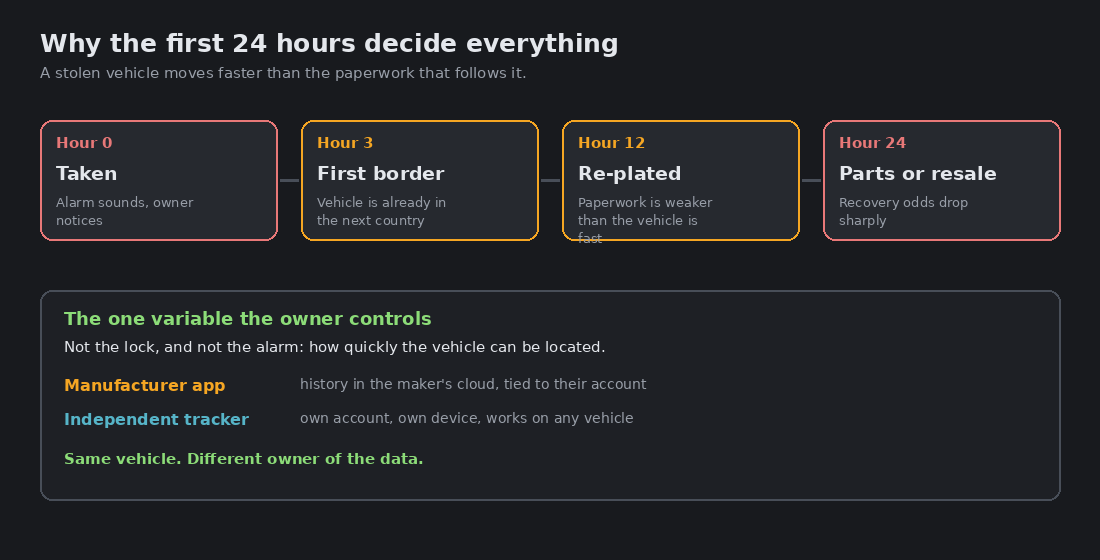
A stolen car crosses a border long before the paperwork catches up. It is one of the quieter cross-border economies: vehicles taken in one country, moved quickly through others, and broken for parts or re-plated somewhere the paperwork is thinner. For the owner, the practical question is not who is to blame but how quickly the vehicle can be found. Increasingly, the answer is not a manufacturer’s service at all.

The gap between the alarm and the border
Factory alarms deter the opportunistic thief and do almost nothing against an organised one. The maker’s connected app is useful, but it is built for convenience, not for recovery: the data sits in a corporate cloud, in another jurisdiction, behind an account the owner may not fully control, and it can go dark the moment a subscription lapses or a platform is retired. In the hours that matter most, that is a fragile chain.
Why the clock matters more than the lock
The independent layer
The alternative is deliberately low-tech and jurisdiction-free: a spare phone hidden in the vehicle, running a tracking app, reporting to an account the owner controls. No manufacturer cloud, no monthly fee, and a route history that survives regardless of what any car maker decides to do with its platform. It is the same principle that has long been used on high-value cargo, applied to the family vehicle. The mechanics are described on the car tracking setup guide.
Which vehicles are most exposed
Cross-border theft tends to follow desirability and port access: full-size pickups and large SUVs, which are easy to move and easy to part out. In North America the perennial targets include the Ram 1500, the GMC Sierra and the Jeep Grand Cherokee; in Europe, popular crossovers and premium models. The full list of covered vehicles, marque by marque, is at cartrack.spysat.eu.
The economics
Commercial tracking costs a subscription and a professional install. The independent route costs a spare phone and whatever the data plan already covers, which is why it has spread among owners of older or high-theft vehicles who see no reason to rent their own location history back from a manufacturer. Whether it is worth ten minutes of setup is, on the evidence, not really in doubt.
Use any tracking only on vehicles you own or are authorised to track.






Leave a Reply